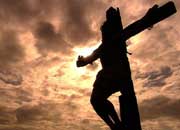
 "Thinking Eternally, Acting Locally." - Neal August
My pastor gave a good sermon on the book of Job this weekend - one of my favorite books. The Book of Job is set during the time of the Patriarchs but was written after the time of the exile.
In a sense, the book (like Ecclesiastes) is a response to the theology taught in the books of Deuteronomy and Proverbs. These latter two books offer a fairly clean cut approach to life in that it plainly states the general cause and effect truth that good begets good and evil begets evil. If we lead moral, righteous lives, we will be blessed by God and his ordained will. If we act immorally and lead unrighteous lives, we will reap bad consequences. This theology is generally true and real life experience bears it out. However, this theological framework does not tell the whole truth. There are times when evil flourishes and the good unjustly suffers. Real life experience bears this out.
The book of Job's purpose is to deal with the theological particular of the righteous person suffering. Job is a righteous individual with strong faith in God. When he suffers blamelessly, his whole theology is shook to the ground. He wonders why God would allow such evil to befall him. His three friends are disturbed by the questions he is raising about how God relates to man and begin to argue with Job, trying to defend God and attempting to correct Job's theology. Much of what Job's three friends espouse is the theology of Proverbs and Deuteronomy. The most interesting part of this book is that Job listens to the theologizing of his three friends and agrees with them. His response is that he agrees with all their theology - it's his theology! - but it just does not fit his circumstance. Throughout his ordeal, Job never loses his faith/trust in God, but wrestles with the theology. From this perspective, the book of Job is about a crisis of theology, rather than specifically a crisis of faith.
Yet, Job remains unshakeable in both his belief in God and in the belief of his innocence.
Sunday, September 14, 2014


Saturday, August 23, 2014
A Fuller Expression of the Gospel
I was reading today a few articles on N.T. Wright and his
view of narrative theology. I came across one article that took him to task for
a less than clear conception of penal substitutionary atonement theology. I
sympathize with the articles frustration over the ambiguity of Wright's
position, though it is obvious that we come down on separate sides when it
comes to the validity of the doctrine. Nevertheless, what really struck me
about the article was the author's dissatisfaction with Wright's book "Simply Christian" in
that it did not explain the basic Gospel -- "Christ died for our
sins."
This is a bit of a bugaboo for me. One of my criticisms of
most conception of the Gospel message, particularly the more popular
understandings, is that they are extremely narrow formulations, completely devoid
of the narrative thrust of the Bible. In effect, to say the basic Gospel is
"Christ died for our sins" is like saying that WWII was about
liberating Poland from Nazi Germany. The saying captures the part but not the
whole.
Granted, a full expression of the Gospel (like the one I
humbly suggest below) does not fit on a bumper sticker or key ring. If one was
to simply reduce the Gospel to its purest essence it would be the following: "The
Gospel is the Good News of the coming of the Kingdom of God" (Matt 4:23;
9:35; 24:14; Mark 1:14). This was the Gospel that Jesus proclaimed and would
have been readily understood by his Jewish contemporaries.
However, outside of first century Palestine, we, like the
gentiles of the era, depend upon the apostles to flesh out the meaning of this
good news and explain it as it related to the story of Israel.
Therefore, the following should be understood: "The
Gospel is the Good News of the coming of the Kingdom of God (Matt 4:23; 9:35;
24:14; Mark 1:14), that God has broken definitively into history and the world
(Luke 4:18) with power (1Th 1:5) and grace (Acts 20:24; Eph 1:13) in the person
and work of Jesus the Christ (1Th 3:2; 2Th 1:8; Gal 1:7; 1Cor 9:12; 2Cor 2:12;
Rom 1:9; Phl 1:27), who is the first fruits of the resurrection (1Cor 15:20,
23), bringing Justice (Rom 2:16), Peace (Eph 6:15), and Healing (Matt 4:23;
9:35) to the World and the offer of Salvation (Rom 1:16) for Repentance and
Faith (Mark 1:14; Acts 15:7) to all peoples, fulfilling the God’s promise to
Abraham (Rom 4:13; Acts 7:17; Gal 3:29) and inaugurating New Creation (Gal
6:15) and the summing up of all things in Christ (Eph 1:10)."
I think this definition offers a far fuller and more
accurate expression of the Gospel and how it was encapsulated by Jesus'
original audience.
Friday, August 22, 2014
Meta-Narratives and the Christian Worldview
Meta-narratives are
generally defined as a comprehensive explanation of historical meaning,
experience or knowledge, which offers a society, culture, or movement legitimization
through the anticipated completion of a (as yet unrealized) master idea.
One of the chief
characteristics of post-modernity is a incredulity towards meta-narratives
based upon the belief that they are created and reinforced by power
structures seeking self-validation and are therefore untrustworthy.
I am not necessarily adverse to this critique of
meta-narratives insofar as it rightly addresses the issue of grand stories told
by a group of people in order to legitimize a particular worldview or
privilege.
However, I do believe that meta-narratives are fundamentally
useful and should not be dismissed offhand but rather critiqued on the basis of
how close they correspond to known reality.
Nevertheless, meta-narratives are too often used for social
and epistemic validation and are the driving force buttressing a particularly
cherished worldview.
Christianity, of course, has its own meta-narrative told through
the stories of the Bible, the person of Jesus, and the Gospel message. However,
the main difference between the Christian narrative and most others is that
instead of a meta-narrative propping up a worldview, Christianity is a
narrative in search of a worldview. It's a complete reverse. Christianity already
has a definitive, over-arching story to be told and understood; it is not
telling new stories in order to validate a pre-existing social order or
conception. At most, Christians are continually re-examining the established
story in hopes of creating a worldview and social order that corresponds with
the narrative.
This is why telling the grand narrative of God's redeeming
work to our children is so central to establishing a proper worldview for Kingdom work. Without
a proper foundation in a proper, grand narrative, children will develop worldviews
(usually unauthentic, self-serving worldviews) and then seek the stories, the
narratives, and the "truths" that seems to best validate that
worldview. The worldview is now buttressing the ego.
Ultimately, all false narratives crack and eventually
crumble when unavoidably confronted with reality, casting doubt upon the
worldview and threatening the individual's self-validating conception.
It is at this critical juncture that the individual has a
choice: either 1) to pursue the truth in the submission of the self towards a
relationship with God in Christ and adopting the proper meta-narrative or 2) to
try continuing with a false, deteriorating narrative with spurious thinking,
self-justification, cognitive dissonance, and a reprobate mind.
Friday, August 08, 2014
Difficulty with the Translation אֶרֶץ ('erets)
One of the more confusing aspect of the Bible is the translation
of the two words: אֶרֶץ
('erets) and γῆ (gē). Both
words have a few different translations but are generally translated as either
"earth" or "land". Here is where the confusion comes in
with translations:
Some of the prophecies of the Old
Testament predict that God will wipe a people from the 'erets. If a Bible
version translates the word as "earth" then the prophecy is often
interpreted as not having occurred (i.e., God has not wiped these particular
people from the earth). However, if the word is translated as "land"
then it can be showed that these people were expelled and can be proven that the prophecy was
fulfilled.
So because of this little translational detail, there are
many Christians who have misinterpreted the Bible and are waiting for particular
events that occurred thousands of years ago.
Thursday, August 07, 2014
"Candle in the Wind", by Alexandr Solzhenitsyn
I finished reading Alexandr Solzhenitsyn's play "Candle
in the Wind", which I found in a nice little bookshop in Newport.
The story is basically about the professional and personal
lives of scientists and mathematicians working at a biocybernetics institute
and how they differ in their reactions to the amorality of their work. But
essentially, the meaning of the work is to examine movements of materialism
divorced from the spiritual, particularly the purposes and uses of science by
the state, and how such socialistic statism suppresses the human soul.
These themes of materialism and the dehumanizing effects of
socialism are all common to Solzhenitsyn. Indeed, Solzhenitsyn, as the last
great Russian writer of modernity, is the successor of Tolstoy in his focus on
the simplicity of the individual soul seeking maturation (specifically the
spiritual) amidst the forces of modernity, particularly materialism and
socialism.
Naturally, being a Russian from the Soviet period,
Solzhenitsyn's stories are located within Russia and explore spiritual themes
in the context of a socialist society (much like Pasternak, Akhmatova, and
Bulgakov). However, in "Candle in the Wind", Solzhenitsyn
intentionally places his story in a nameless state devoid of identifying cultural
markers in order to create a more international feel and universal quality. How
effective he is with this technique is open for criticism. Personally, I think
the universal quality of his theme itself would lift the story out of a Soviet
context and unto a broader, international stage.
I was quite reminded of the plays of Tom Stoppard,
particularly the critique of socialism, the analogies of science, mixed with
wit and the personal lives of the characters. I particularly loved the first
few lines:
Maurice: One of the main criteria for judging people's taste
is cheese. What cheese do you prefer, Alex?
Alex: I'm no connoisseur, Uncle, they're all the same to me.
Maurice: All the same? You really are a savage, then!
"Candle in the Wind" is a minor work by a major writer.
It's a quick read and a good primer for his more expansive works.
Saturday, August 02, 2014
Freedom or Death, by Nikos Kazantzakis

Today I finished reading "Freedom or Death", by
Nikos Kazantzakis. I've been a huge fan
of Kazantzakis for many years now and was glad that I finally got around to
reading this particular work.
Ostensibly, the book is about the rebellion of the Cretans against the Ottoman Empire in the
year 1889, seen through the eyes of Captain Michales.
Kazantzakis, of course, goes deeper, meditating upon the
Cretan psyche in terms of its identity, nationalism, religion, and character.
I also think that there is an undercurrent of the
ever-present Minoan ethos that figures so prominently in most of Kazantzakis'
works (he was born in Crete). Strip away the philosophical and cultural
flourishes of a Kazantzakis work and you'll find a pre-historic, earthy, almost
proto-mythic quality that reduces humanity to the simplicity of a life/death
dichotomy. Such a philosophical bent is not untypical of modernist writers but
it seems always more heightened with Kazantzakis.
I think you also find such thinking in the Old Testament
wisdom literature of Ecclesiastes and Job. The Book of Job in particular has as
its base point the understanding that the individual human exists for a brief
moment between two abysses and that the only positive choice is a full leap of
faith into the creator God.
Kazanzakis, like many of the best modernist writers,
understood the situation of man as existing between two voids, but,
unfortunately, unlike writers such as Hermann Broch, he rejected the positive
choice of falling into the infinity of God but instead embraced and explored a
synthesis of life-death as an alternative to God.
So I don't agree with Kazantzaki's conclusions, but I
greatly appreciate and am interested in his exploration of the theme of man's primal,
existential situation.
All in all, I think that "Freedom or Death" is a
very good book, though I don't think that it rises to the levels of other such
Kazantzakis' works such as "The Greek Passion", "The Last
Temptation", or "The Odyssey: A Modern Sequel". It is certainly
better than the vastly over-rated "Zorba the Greek".
"Sin" in 2 Corinthians 5:21
I've been doing a study on 2 Corinthians 5:21, specifically
about the odd saying that "God made him who had no sin [i.e. Jesus] to be sin for us".
This verse has traditionally been interpreted to mean that by some mystical
transference God turned Jesus into sin during the crucifixion in order to be
substitutionally punished for the sins of humanity. However, I had noticed that
several of the better, scholarly translations of the New Testament add a footnote
to the second occurrence of "sin" (hamartia) in verse 21, indicating that it can be
translated as "sin-offering".
The
reason for this is that the Old Testament uses the same word (chatta'ath) for both "sin" and
"sin-offering". Only contexts determines the usage.
Therefore,
we get a translation of Leviticus 4:3: "If the anointed
priest sins, bringing guilt on the people, he must bring to the Lord a
young bull without defect as a 'sin offering' [chatta'ath]
for the 'sin' [chatta'ath] he has committed."
Now
when the Hebrew Bible was translated into the Greek Septuagint (LXX), the
translators rendered chatta'ath as hamartia.
With
this in mind, the atonement context of 2
Corinthians 5:21 suggests that Paul intended the second use of hamartia to be understood as
"sin-offering" instead of "sin".
It
makes more sense to think of God considering the sin-less Jesus an offering for
sin than actually somehow turning him into sin.
Thursday, July 03, 2014
Two Approaches to Christianity
There are two different practical approaches to being a
Christian in today's world. The first approach is the most common and considers
the Christian faith as a means by which one gets through this life. This
approach generally manifests itself in the view that life is life and the
Christian faith helps one get through it with utmost help. There are varieties
to this approach. Some choose to follow Christianity but believe it is not so
much different than any other religion. They generally follow Christianity
because they are culturally conditioned to do so. Other varieties of people
truly believe that Christianity is the one true faith, ordained by the creator
of the universe, and that Jesus Christ is the only way to be saved.
Nevertheless, these same people still perceive Christianity as a faith that
helps them get through life. For them, Christianity is either a form of
"self-help" psychotherapy or a means of "health and wealth"
creation. The second approach is radically different. This approach considers
the Christian faith as life itself and that the believer is definitively called
into a life- and world-changing mission to advance the Kingdom of God and work
towards New Creation. The first approach is about improving the self for the
purposes of the self. The second approach is about denying the self for the
purposes of the overall mission of God in Christ. The first approach is about
reading a story. The second approach is about being a character in the story.
On the Translation of the Word אֶרֶץ ('erets)
One of the more confusing aspect of the Bible is the
translation of the two words: אֶרֶץ ('erets) and γῆ
(gē). Both
words have a few different translations but are generally translated as either
"earth" or "land". Here is where the confusion comes in
with translations:
Some of the prophecies of the Old
Testament predict that God will wipe a people from the 'erets. If a Bible
version translates the word as "earth" then the prophecy is often
interpreted as not having occurred (i.e., God has not wiped these particular
people from the earth). However, if the word is translated as "land"
then it can be showed that these people were expelled and can be proven that the prophecy was
fulfilled.
So because of this little translational detail, there are
many Christians who have misinterpreted the Bible and are waiting for
particular events that occurred thousands of years ago.
Sunday, May 25, 2014
Reasons for the Crucifixion of Jesus
For those unfamiliar with Christianity or those only culturally tied to
it as a religion, there can be some confusion and uncertainty about the meaning
and purpose of Jesus' crucifixion as it pertains to the Christian Faith. I'd
like to offer four primary reasons for the death of Jesus, in brief:
Reason 1: Servant - In this, Jesus obeyed God and followed the
divine will perfectly throughout his life even to the point of death. Jesus
was the perfect human being as God always intended, representative of both God
and Man, selflessly denying himself for the love of his fellow man and God,
giving himself in obedience to God, even into death, for the purposes of God's
saving work. Here, the grace of God is shown in that for whoever trusts God and
follows Jesus, God recognizes in them the same selfless obedience that God sees
in Jesus.
Reason 2: Moral-Theological
Example - Jesus' obedience and selflessness is the ultimate expectation
that God has for humanity, both as individuals and as a community. If Jesus is
the ultimate human and a sign-post pointing forwards to God's consummation of
creation, disciples of Jesus are called to follow his example in their daily
lives, even to the point of self-sacrificial death.
Reason 3: Defeat of Evil - The
resurrection that followed Jesus death from crucifixion ultimately shows that
evil and all the dark forces that the world can muster can never have the final
victory over Jesus and his followers. If killing is the ultimate act that one
can do to another, if death is the worse destruction that evil can do, then the
fact that Jesus overcame death by crucifixion and was resurrected into a
glorified body means that evil can do its worse and not have victory over good.
Jesus defeated both evil and death and all those who follow Christ participate
in that victory. This is also the reason why there cannot be any justice in the
world without a resurrection of the body from death.
Reason 4: Enacted Parable - This
is a difficult one. In order to grasp it, we must peal back centuries of
established theology (both correct and incorrect) in order to look at the
immediate role and self-understanding that Jesus had of himself as a prophet in
first century Palestine, warning his contemporaries about the threat of Rome
and God's imminent judgment upon the nation of Israel. Jesus was deeply steeped in the Jewish prophetic traditions, both
in terms of metaphor and method, particularly in how Old Testament prophets
acted out God's message and even upcoming judgment (see Isaiah, Jeremiah,
Ezekiel, etc.). In this way, Jesus,
in his crucifixion, was acting out the destruction of Israel by Rome. He was
demonstrating through a prophetic act that if the people continued their way of
being Israel and did not turn to God's way (the way of Jesus), then Rome would
attack and destroy Israel. Rome would treat the people of Israel as enemies of
the state and crucify them, which is exactly what happened in AD 70.
Monday, April 14, 2014
The Occupation of Jesus

Traditionally, it has been believed that Jesus was a carpenter by
trade. This is due to the passage in the Gospel of Mark that states of Jesus,
"Is not this the carpenter, the son of Mary?" (Mark 6:3)
The Greek word used for "carpenter" here is tektōn (τέκτων) which can be translated as
"craftsman", but it can be applied to both wood-work and stone-work.
So, technically, Jesus could have been either a carpenter or stone-worker.
Now when we look at the words of Jesus as they
are recorded in the Gospels we see an abundance of references to stone-working:
Building foundations (Matt 7:24-27; Luke
6:48-49), faith as a foundation rock (Matt 16:18), building towers (Matt 21:33;
Mark 12:1; Luke 14:28), falling towers (Luke 13:4), cornerstones
(Matt 21:42-44; Mark 12:10; Luke 20:17-18), temple stones (Matt 24:2; Mark 13:1-2; Luke 21:6), millstones (Matt 18:6; Mark 9:42;
Luke 17:2), nicknaming Peter,
rock or stone (Matt 16:18; John 1:42), and other
general references to rocks and stones (Matt 4:6; Matt 7:9; Luke 4:11; Luke
11:11).
Contrast these to the lack of references to wood and wood-building in
the Gospels. When Jesus mentions trees, the references are exclusively
agricultural (fruit trees, etc.).
Based solely upon the ambiguity of the word tektōn
and the more frequent use of stone analogies in his words and teachings, I
submit that Jesus was more likely a stone-worker than a carpenter.
Monday, April 07, 2014
ELOI ELOI LAMA SABACHTHANI
One of the more significant misunderstandings people have when reading the Gospels is the belief that God the Father rejected or turned his back on Jesus during the crucifixion.
This confusion is largely derived from Jesus' crying out on the cross “ELOI, ELOI, LAMA SABACHTHANI?” which is translated, “MY GOD, MY GOD, WHY HAVE YOU FORSAKEN ME?” (Mark 15:34).
At first look the idea that Jesus is p...roclaiming that God has forsaken or rejected him seems fairly straightforward. Certainly, everyone at the time believed that Jesus was in this situation because God was not with him (Mark 15:29-32).
However, Jesus' cry of "ELOI, ELOI, LAMA SABACHTHANI" is actually an Aramaic translation of Psalm 22:1. If you read the entirety of Psalm 22 a far different picture emerges of what is going on in Jesus' situation.
The Psalm tells of a figure who is crying out to God in desperation. He is in the worst of circumstances. It looks like his enemies have conquered him. They laugh at his affliction. Everyone believes the figure has been deserted by God.
BUT ... in verse 24 we read the following:
"For He has not despised nor abhorred the affliction of the afflicted; Nor has He hidden His face from him; But when he cried to Him for help, He heard."
The whole purpose of Psalm 22 is to show that even though it seems like God has turned his back on the figure, in fact, God has been with that person the entire time. He has not rejected.
So when Mark includes Jesus crying out the first line of Psalm 22, he is pointing to the entire Psalm and its meaning, arguing that, just like in the Psalm, even though it seems like God has rejected Jesus, the exact opposite is true: God is with Jesus the entire time him.
The people who gathered at the cross to watch Jesus be executed with the brigands were oblivious to this. In fact, Mark highlights their confusion by saying that when they heard Jesus say, " ELOI, ELOI", they thought he was saying "Elijah, Elijah" (Mark 15:35).
Interestingly, so many of us get this wrong, too. The original readers of Mark would have gotten the literary allusion and understood the meaning: God did not reject or turn his back on Jesus during the crucifixion.
This confusion is largely derived from Jesus' crying out on the cross “ELOI, ELOI, LAMA SABACHTHANI?” which is translated, “MY GOD, MY GOD, WHY HAVE YOU FORSAKEN ME?” (Mark 15:34).
At first look the idea that Jesus is p...roclaiming that God has forsaken or rejected him seems fairly straightforward. Certainly, everyone at the time believed that Jesus was in this situation because God was not with him (Mark 15:29-32).
However, Jesus' cry of "ELOI, ELOI, LAMA SABACHTHANI" is actually an Aramaic translation of Psalm 22:1. If you read the entirety of Psalm 22 a far different picture emerges of what is going on in Jesus' situation.
The Psalm tells of a figure who is crying out to God in desperation. He is in the worst of circumstances. It looks like his enemies have conquered him. They laugh at his affliction. Everyone believes the figure has been deserted by God.
BUT ... in verse 24 we read the following:
"For He has not despised nor abhorred the affliction of the afflicted; Nor has He hidden His face from him; But when he cried to Him for help, He heard."
The whole purpose of Psalm 22 is to show that even though it seems like God has turned his back on the figure, in fact, God has been with that person the entire time. He has not rejected.
So when Mark includes Jesus crying out the first line of Psalm 22, he is pointing to the entire Psalm and its meaning, arguing that, just like in the Psalm, even though it seems like God has rejected Jesus, the exact opposite is true: God is with Jesus the entire time him.
The people who gathered at the cross to watch Jesus be executed with the brigands were oblivious to this. In fact, Mark highlights their confusion by saying that when they heard Jesus say, " ELOI, ELOI", they thought he was saying "Elijah, Elijah" (Mark 15:35).
Interestingly, so many of us get this wrong, too. The original readers of Mark would have gotten the literary allusion and understood the meaning: God did not reject or turn his back on Jesus during the crucifixion.
Thursday, March 06, 2014
Beck's Morning Phase: A Review

It's always a well-anticipated celebration when a new Beck album is
released. In terms of comparison, I think many of us feel the same way about a
new Beck album as we do about a new Radiohead album. We are certain that we are
in for a treat, and we know that we will be exploring shining new areas of
musical exploration. And, once again, Beck doesn't disappoint.
It has been six years since Beck released his last album, Modern Guilt (2008). In the interval,
the so-called original 90s slacker musician explored a number of other musical
projects.
In 2009, he began Record Club,
a project to cover an entire classic album by another artist in one day (The Velvet Underground, Leonard Cohen,
INXS, Yanni), using an informal
and fluid collective of peer musicians. The covered
performances were video recorded and then posted on Beck's website.
In 2012, he released Song Reader, a work of 20 original songs presented
only as sheet music, in the hopes that enterprising musicians will record their
own versions. If you go on Youtube you can find various performances of each of
these songs by various musicians.
He also wrote a few songs for soundtracks, collaborated with other
musicians, and produced a few albums for others, most notably the Charlotte
Gainsbourg's IRM (2009). Here is an
album for which Beck produced, wrote every song (except one cover), played on
every song, and sang on a few of them. Apart from Charlotte Gainsbourg's vocals
and name and picture on the cover, what keeps this record from being considered
a regular Beck album?
So what comes after a much too long gap in between records is Beck's glorious Morning Phase.
According to press releases and other promos, Morning Phase is
to be considered a "companion piece" to his 2002 album Sea Change. The comparison is accurate
and everyone who listens to the new work will see the affinities. As is
generally known, half of Beck's oeuvre is dedicated to more acoustic-based
albums (see One Foot In the Grave
[1994], Mutations [1998], Sea Change [2002]) on which he often
overlays lush orchestrations, dense layers, and his own distinctive sounds.
Such albums are often more melodic and uniform than his alternative-hip-hop-focused
work with the Dust Brothers as producers (Odelay
[1996], Midnite
Vultures [1999], Guero [2005]).
Both Mutations and Sea Change were produced by famed
Radiohead producer, Nigel Godrich.
Morning Phase falls within
this acoustic-based category and includes much of the harmonies, immersive
orchestrations, and the melancholic and introspective tones that were so
distinctive on Sea Change.
Sea Change is a more
distinctive album and is usually the album most liked by people who either do
not like Beck or are suspicious of his talent. This album was a worthy
successor to the surprisingly good Mutations
but came jarringly after the tongue-in-cheek Midnite Vultures.
Sea Change came across as
more of a concept album delving into the break-up of a relationship. The ironic
lyrics of his previous albums were replaced by more sincere, simpler lyrical
content. Again, a far deeper and sad Beck than we had seen before. A very
sub-surface melancholy that drew inspiration from Nick Drake, Bob Dylan's Blood on the Tracks, and Serge
Gainsbourg (listen to the strong
affinities between "Paper Tiger" and Histoire de Melody Nelson).
While I do not think that the songs on Morning Phase are as strong as some of the ones on Sea Change ("The Golden Age",
"Paper Tiger", "Already Dead"), the overall work is far
more satisfying. There is an even stronger uniformity and thematic wholeness. This
is a concept album, but one returning to semi-familiar territory.
In an article for Rolling Stone, David Fricke wrote the following about
his interview with Beck:
"But Beck is loathe to use the word
"sequel" to characterize Morning Phase.
'It was going back to the same place,' he says, 'and seeing where we're all at,
like those Seven Up! movies, where they go
back and see those people every seven years.'"
In Morning Phase, Beck is returning to the broken relationship of Sea Change to see what remains and to see if the small light still glowing has any chance of growing. He seems to want to take us on a personal, deep journey of inspecting the shipwreck of a relationship to see if anything can be salvaged, invoking strong images of water, light and turning. I'm reminded of similar tonal explorations with The Moody Blues (Days of Future Passed) and, to a lesser extent, The Who (Quadrophenia). Again, comparisons with Nick Drake, Serge Gainsbourg and 70s Bob Dylan emerge.
In Morning Phase, Beck is returning to the broken relationship of Sea Change to see what remains and to see if the small light still glowing has any chance of growing. He seems to want to take us on a personal, deep journey of inspecting the shipwreck of a relationship to see if anything can be salvaged, invoking strong images of water, light and turning. I'm reminded of similar tonal explorations with The Moody Blues (Days of Future Passed) and, to a lesser extent, The Who (Quadrophenia). Again, comparisons with Nick Drake, Serge Gainsbourg and 70s Bob Dylan emerge.
Not surprisingly, given this thematic material, there is far more
uncertainty here than there was in Sea
Change.
Here are my thoughts and analysis of the songs:
"Cycle",
"Morning"
The short intro, "Cycle", followed
by "Morning," open the work and immediately set the tone. "Cycle"
gives us inundating waves of orchestration. It is just a short string piece,
symbolic of the swell of the morning, the rise of the sun, yet again, the cycle
of day and night. It soon flows into the daybreak of "Morning", a
song that expresses the hope and possibility that a once shattered relationship
can be revived. The tone is that of
daybreak and the first rays of light. The song itself recalls "The Golden
Age", the first track of Sea Change.
If that song is about realizing you need to start over (but being unable to
even try), "Morning" more or less covers the same idea, but instead
of looking forward at an unknown road, wondering how to get there, it looks
backwards and realizes, I may have just survived (and am all the wiser for it).
Those distant lights he could not locate in "The Golden Age" seem to
have been found in the first lines of "Morning."
The lyrics read:
"Woke up this morning, found a love
light in the storm
Looked up this morning, saw the roses full of thorns
Guns are falling, they don't have nowhere to go
Oceans of diamonds always shine, smooth out below"
Looked up this morning, saw the roses full of thorns
Guns are falling, they don't have nowhere to go
Oceans of diamonds always shine, smooth out below"
These are images of morning, light, and water - images that will pervade
the entire work.
"Heart is a Drum"
"Heart is a Drum" reminds me both of solo Tom Petty (Full Moon Fever, Wildflowers) and some of the more poetic moments of Adore-era Smashing Pumpkins.
The water imagery continues with lyrics such as "Everyone, if they drown from the undertow" and "'Til all
my days are drowning out".
"Say Goodbye"
In his review, Will Hermes of Rolling Stone Magazine noted that
"Country Down" was reminiscent of Harvest-era
Neil Young. I can just barely see that, but I think the similarities are more
evident here on "Say Goodbye".
"Blue Moon"
"Blue Moon" is the first single
released for the album. It's a good song with more water imagery ("Songbird
calling across the water") and a "turning" reference ("See
the turncoat on his knees
A vagabond that no one sees"). For some reason or other, Beck has likes to use the word "vagabond" in his lyrics (also "convalescence").
A vagabond that no one sees"). For some reason or other, Beck has likes to use the word "vagabond" in his lyrics (also "convalescence").
There is, of course, a very famous song called "Blue Moon,"
one of Elvis' biggest and earliest hits. It includes the lines "Blue moon
/ you saw me standing alone" and clearly uses the rare event of a blue
moon to symbolize the rare event of finding love. Beck uses a line or two as a
jumping point for his own song ("I'm so tired of being alone").
"Blue Moon"'s music infuses the dark themes with a bit of
hope, the chirpy clavinet and gorgeous vocal harmonies bringing some uplift to
its lonesome lyrics. The song is about feeling trapped, and a longing to be
saved.
"Unforgiven"
Rolling Stone, having heard a preview, compared the song to Gram
Parsons and David Crosby.
"Wave"
The strings from "Cycle" resurface in "Wave"
reinforcing the thematic unity of the work. The song has the orchestrations
that reminds one of Radiohead's Kid A
(no Nigel Godrich here, though) or a Bjork album. But the lyrics and wave
imagery hearken back to Sea Change.
"If I surrender and I don't fight this
wave/No I won't go under/I'll only get carried away".
"Don't Let It Go"
One of the three best songs on the album.
"Blackbird Chain"
"Blackbird Chain" seems to come straight out of Mutations-era Beck and naturally finds
its place within the work. The music does mix different sounds into an
essentially country form, including a very soulful bassline and subtle strings.
"Phase"
Another instrumental piece that continues the orchestrations from
"Cycle" and "Wave".
"Turn away"
"Turn Away" continues the theme of the light that signifies
the hope of a renewed relationship. Vocally, it sounds like Beck singing with
himself. Personally, I found it to be too repetitious and jarring. I think it
is the weakest song on the album. The orchestration is nice. Too much Simon and
Garfunkle.
Lyrically, though, it fits right in with some of the light and, of
course, "turning" themes of the album.
"Hold hold the light
That fixes you in time
Keeps you under
Takes you over the wall
That love divides between waking and slumber
Turn away"
That fixes you in time
Keeps you under
Takes you over the wall
That love divides between waking and slumber
Turn away"
"Country Down"
"Country Down" is a Dylan-esque song full of water imagery of
rivers, floods, undertows, and waves. "Turning" references abound.
There is also this striking lyric combining both water and "turning"
images:
"All along the floodline/Waves are
turning around"
It is evident that in both Sea
Change and here in Morning Phase,
Beck associates water imagery with relationship. It is also evident that Beck's
lyrics reach out for that desire to return that relationship to its former
state.
This song, along with "Blackbird Chain" and "Waking
Light", came out of Beck's Nashville recording sessions for what was
originally to be a fairly traditional
country album. He never was fully satisfied with the results, and ended up
shelving it, but he did keep 3-4 of the songs and brought them to the Morning
Phase sessions a few years later.
"Waking
Light"
The album ends with another aching morning
song, "Waking Light."
Rolling Stone refers to the song's "Leslie-guitar crescendo,"
which reminds them of George Harrison's guitar solo on "Let It Be."
I'm sure there is more to explore in this album than I've already
indicated. I suspect that Beck may have also continued the "road"
theme from Sea Change on this album.
More exploration needed.
The title of the album is a slight pun: "Morning Phase" and
"Mourning Phase". It is a time of mourning over a failed relationship
but also considerations of whether return is possible and whether anything that
remains can be salvaged and rebuilt.
I enjoyed almost every song on this album ("Say Goodbye",
"Don't Let Go", and "Blackbird Chain" being the highlights)
and found that I could listen to the entire work in one sitting and do so
repeatedly. This only enhanced my appreciation for the conceptual unity of the
work. The only song that I did not care much for was "Turn Away", for
reasons stated above.
I think that this is probably the best Beck album since Mutations, one
of my top three favorite Beck albums and once one of my top ten favorite albums
until it was pushed out by Danielson's Ships
(both Mellow Gold and Odelay remain in my top ten). I also think it signals that Beck has reached a new level of artistic maturity, and I look forward to what I suspect in several years will be the third part of a Sea Change-Morning Phase-X Trilogy.
Friday, January 31, 2014
The Lever and the Tiger
Let us suppose that you are confronted with a wall. On the
other side of that wall are two separate rooms. There is a door between these
two rooms. In one room is a hungry, man-eating tiger. In the second room, there
may or may not be a human being.
You are presented with a lever. If you pull the lever, the
door between the two rooms will open and the hungry, man-eating tiger will be
able to enter the other room. If there is no human in the other room, then no
life will be terminated. If there is a human in the other room, then that human
will be killed by the hungry, man-eating tiger.
Therefore, if you are uncertain as to whether or not there is
a living person in the other room but are given the free choice on whether or
not to pull the lever, do you, in uncertainty, choose to pull the lever?
"Hateful" Comments
When you see "hateful" comments on Youtube, Twitter,
a news website, or other internet webpage and want to draw conclusions about
the country, consider the following:
- 500 negative comments in a nation of 300 million.
- How many of these negative comments are international in
origin?
- 500 negative comments in a world of 6 billion.
- How many of these negative comments are from adults and
how many are from middle schoolers?
- What is the motive for such negative comments? Trying to joke
ironically? Trying to get a row out of you? Trying to make you think that a
certain segment of the population is "hateful". Trying to create
controversy so they can use the controversy advertise the issue/product
publicly?
The virtual anonymity of the internet creates the situation
in which one is uncertain as to the location, age/maturity, or motivation of
anyone who posts "hateful" comments in such a public forum. This
ambiguity of intent creates a vacuum that people attempt to fill with their own
speculation, usually based on their own biases, presumptions, pet peeves, and
worldview. Therefore, it can be easy to misjudge a situation and be deceived.
At the very least, there is the strong possibility that
people who post "hateful" comments in a public forum are attempting
to manipulate your emotions for personal gain. Don't give people the power to
influence you in this regard.
Monday, December 23, 2013
MY TOP ALBUMS OF 2013
"The Devil Put Dinosaurs Here", Alice in Chains
"Mala", Devendra Banhart
"The Next Day", David Bowie
"Be the Void", Dr. Dog
"Histoire de Melody Nelson", Serge Gainsbourg
"The 2nd Law", Muse
"King Animal", Soundgarden
"High Rise", Stone Temple Pilots
"The Whole Love", Wilco
"Fly from Here", Yes
Saturday, December 14, 2013

Monday, December 09, 2013
Responding to Oppression II
I'm not very political. At all. My theology has
developed over the past two decades to the point where I am completely immersed
in the methods of Jesus and the Sermon on the Mount. I do not march, picket,
boycott, protest, sue, vote, write to my congressman, or engage in any activity
that I think employs the political methods of this world. Instead, I get on
with the slow, steady, work of the Kingdom in full assurance of my success and
the success of the Kingdom.
Therefore, I do not delve into or am bothered by the
daily machinations of the current culture war. I really couldn't care less. If
a nativity scene or cross or monument to the Ten Commandments is taken down from
a public place, it doesn't faze me. I don't cry out for justice when someone is
told not to use Jesus' name in a public prayer or if prayer is
"prevented" at all.
However, I am extremely bothered when the government
begins to order private citizens to go against their personal faith.
I have been closely following a number of the legal
cases around the country in which businesses own by Christians are being forced
to provide abortion causing drugs to employees and in which florist and
cake-decorating businesses are being forced to provide their services to
same-sex marriages. I find this completely unconscionable.
I read an article this morning in which a judge ordered
that a Christian baker must serve gay couples for same-sex ceremonies despite
his religious beliefs or face fines. Obviously, the gay couple who sued this
Christian baker could have gotten a cake elsewhere (and probably did). Their
interest and objective was not to get a cake but to employ the government to
force the owner of this private business to deny his religious beliefs and acquiesce
to how they believe all society should behave.
Now what if this case goes all the way to the top of
the American judicial system and the final decision is that this baker and all
other Christian businesses are to be forced to provide their services to
same-sex marriages, what should the Christian response be?
The decision is actually very easy though the
implementation is of the upmost difficulty.
Three choices:
1) Acquiesce and submit to imposed government authority
and violate Christian faith
2) Close up shop and seek a business or sphere of
society in which one is not confronted with challenges to Christian conscience
3) Ignore government imposition and carry on in
defiance
Let's be honest: human nature being what it is (Christian
or otherwise), the vast majority of believers will choose one of the first two
options (probably the latter rather than the former). More's the pity. Most
people have neither the guts nor the faith to actually take their religious
beliefs all the way to the logical conclusion. They will voice outrage and
protest if a nativity scene or cross or monument to the Ten Commandments is
taken down from a public place because it's easy to do so and one risks very
little by participating.
Nevertheless, the correct choice is number 3, to
completely ignore what the government says in this matter and proceed as before
in full knowledge that you are doing the right thing. Again, this is actually a
very easy choice to make but the implementation of it is extremely difficult
and requires much self-sacrifice.
Here's how it would go:
- The government states that you as a baker must violate
your Christian faith and provide their services to same-sex marriages.
- You refuse.
- The government fines your business.
- You refuse to pay the fine.
- The government orders your business to close.
- You refuse to close your business.
- The government arrests you.
- You go to jail, but, as soon as you are released, you
reopen your business.
- You continue to mind your business in defiance of the
law and in good conscience until either the government relents or you yourself
are spent to the very core of your soul.
Of course, this is easier said than done, and I do not
believe that most Christians have the faith to defy society and government to
this extent. However, this is really what Christians should do and it is the
only way in which freedom of religious practice and expression is to be
realized.
Wager of Peace?
I've been practically gagging these past few days in my attempts to stomach the celebrations given to Nelson Mandela. It's so difficult for me to hear people from across the political spectrum and from every walk of life state that Mandela was a man of peace who waged non-violent resistance on the apartheid system.
I think the kicker was this article at the Associated Baptist Press: Nelson Mandela: Wager of Peace.
I think the kicker was this article at the Associated Baptist Press: Nelson Mandela: Wager of Peace.
Wager of peace?
Nelson Mandela founded the terrorist organization "Umkhonto
we Sizwe" (MK) in 1961 that carried out hundreds and hundreds of bombings
on government installations, shopping centers and restaurants. He personally
ordered these bombings. He was labeled a terrorist because of it. He went to
prison for 27 years because of it. He was offered release numerous times if
only he would renounce violence. He refused. And believe me, these bombings
killed far more blacks than whites. And he, the MK, and the African National
Congress (ANC) violently terrorized and tortured their own people to squash any
collaboration and compromise with the apartheid government of South Africa. As
late as 1988, Mandela refused to renounce violence as a means to end apartheid.
Throughout the 1980s, the government of South African was in negotiations with
the ANC to end apartheid on condition that they end the violence and break off
relations with the Soviet Union, Mandela refused. The bombings of civilians in
the 1980s continued. It wasn't until the break up of the Soviet Union and the
end of their support that Mandela and the ANC were willing to renounce
violence.
I'm sorry but no matter how noble his cause, Mandela never had a problem
using excessive violence to reach his goals. There is nothing Christ-like about
this. This is completely foreign to the non-violent teachings of Jesus. For
people to compare Mandela to Ghandi or Martin Luther King Jr. and others who
actually did apply the teachings of Jesus is to do a great injustice to
true non-violent resistance.
Wager of peace? Unfortunately, Mandela waged violent war.
There was nothing peaceful about what he did.
Saturday, December 07, 2013
Responding to Oppression I
Over the past three days I have been meditating upon the
manner in which one responds to societal oppression. In particular I was
thinking about South Africa in the 20th Century and the more recent news coming
out of the Central
African Republic. How do we react to oppressive regimes and violent
brutality?
Appropriately enough, the Jewish holiday of Hanukkah has
just concluded, which celebrates in part the violent but nevertheless successful
rebellion of 2nd century BCE Jews led by Judas Maccabeus over the brutal
oppression of the Seleucid Empire. Despite the success, the methods employed
had a detrimental effect upon the psyche of the majority of the nation to the
point that they continually adopted a brigand's means of violent revolution to
Roman occupation and oppression in the 1st century CE.
One of the main thrusts of Jesus' prophetic message to 1st
century Jewish people was that their current methods of responding to Rome
would lead to the destruction of the nation (see the Sicarii and Simon
bar Kokhba). These were the violent methods that they had adopted since
the Maccabean Revolt that to them had proved obviously effective. Instead,
Jesus called on the people to abandon their current way of being God's people
and follow his way - a way so notably
put forth in the Sermon on the Mount (Matthew 5-7).
I don't think anyone would suggest sitting down and allowing
brutality to happen, but that does not mean that one should respond with
brutality. One can engage in active non-violent resistance (see Jesus, Ghandi,
MLK Jr., etc.) without using the methods of the enemy. While violent resistance
does lead to immediate results, the results can just as immediately be overturned
by the same methods. Such methods also have a debilitating effect upon the
psyche of both the wielder and the victim. Non-violent resistance is usually a
far more gradual process of political change that requires both patience and
maturity, but the results are far more difficult to reverse. It also has an
uplifting effect upon the psyche (see Jesus, Ghandi, MLK Jr., etc.).
The best way of responding to oppression, brutality,
violence, and evil, the most human way, the way that most clearly reflects the
image of God in this world, is the method of love, mercy, self-denial, forgiveness,
peace, and turning the other cheek.
This is not the easiest road and it is certainly not the
method of immediate self-gratification, but it is by far the most effective
means of establishing permanent and positive societal change.
As we proceed through the Christmas season, let us meditate
upon peaceful approaches societal problems and, most importantly, evaluate the methods
of the political leadership we too often tend to idolize.
Friday, August 23, 2013

Sunday, July 07, 2013


Friday, July 05, 2013
Tuesday, June 18, 2013

Tuesday, June 04, 2013
What Hinders Baptism?
I read this line in a Baptist Press article. I've highlighted my point of interest.
"Because the seminary is not a church and does not have the authority to baptize, SBTC President Jim Richards said the baptismal pool will provide a place for churches that do not have a baptismal and a place for students to practice the ordinance before entering formal full-time pastoral ministry."
Why doesn't the seminary have the authority to baptize? Do not all believers have the authority to baptize? Did not Christ himself give all believers the authority to baptize?
Actually, HE was given the authority and then commanded us to baptize.
“All authority in heaven and on earth has been given to me. Therefore go and make disciples of all nations, baptizing them in the name of the Father and of the Son and of the Holy Spirit, and teaching them to obey everything I have commanded you. And surely I am with you always, to the very end of the age.” (Matthew 28:18-20)
I wonder if only churches have the authority to make disciples and teach. If that is so, then the seminary will have to close down.
And we are baptized into Christ, not the Church.
Sure, we are often bapitzed IN a church building. And we often become members of a church when baptized (providing all the proper forms have been filled out and are accurate, though sometimes such red tape can be done retroactively depending upon the individual situation).
I am quite partial to the story of Philip and the Ethiopian eunuch in Acts 8. Philip teaches the Ethiopian and then he baptizes the Ethiopian. No "church" in site (Intended joke). [For another great joke, see The Humour of Deutero-Isaiah in Isaiah 56:3-5]
In fact, when wanting to be baptized, the Ethopian asked one of my favorite questions in the Bible: "What hinders me from being baptized?" (v. 36)
Really, what does hinder baptism?
"Because the seminary is not a church and does not have the authority to baptize, SBTC President Jim Richards said the baptismal pool will provide a place for churches that do not have a baptismal and a place for students to practice the ordinance before entering formal full-time pastoral ministry."
Why doesn't the seminary have the authority to baptize? Do not all believers have the authority to baptize? Did not Christ himself give all believers the authority to baptize?
Actually, HE was given the authority and then commanded us to baptize.
“All authority in heaven and on earth has been given to me. Therefore go and make disciples of all nations, baptizing them in the name of the Father and of the Son and of the Holy Spirit, and teaching them to obey everything I have commanded you. And surely I am with you always, to the very end of the age.” (Matthew 28:18-20)
I wonder if only churches have the authority to make disciples and teach. If that is so, then the seminary will have to close down.
And we are baptized into Christ, not the Church.
Sure, we are often bapitzed IN a church building. And we often become members of a church when baptized (providing all the proper forms have been filled out and are accurate, though sometimes such red tape can be done retroactively depending upon the individual situation).
I am quite partial to the story of Philip and the Ethiopian eunuch in Acts 8. Philip teaches the Ethiopian and then he baptizes the Ethiopian. No "church" in site (Intended joke). [For another great joke, see The Humour of Deutero-Isaiah in Isaiah 56:3-5]
In fact, when wanting to be baptized, the Ethopian asked one of my favorite questions in the Bible: "What hinders me from being baptized?" (v. 36)
Really, what does hinder baptism?
Monday, February 11, 2013
The Next Pope? An Inquiry

Did you hear? Pope Benedict XVI is resigning as Bishop of
Rome. Now comes the biggest steeple chase in 600 years (unless you count Adrian
Roger’s retirement from Bellevue Baptist Church in Memphis). Soon Cardinals
from north, south, east, and west (including St. Louis) will converge on
Vatican City to see who will be chosen as the next Pope.
Let me state now publicly that I am removing my name from
consideration. First, I already have a lot on my plate and second, I don’t
think I would like the commute to Rome each morning. Sorry, no Pope Nicolas
Beck I.
But allow me to make three recommendations for the next
Pope: Hans Küng, Father Guido Sarducci, and U2’s Bono. (I think Sinead
O’Connor removed herself from any consideration after that 1992 incident on
SNL)
Here are the positives and negatives of each candidate:
Hans Küng is probably the leading theologian of the Roman
Catholic Church and a best-selling author (see “On Being Christian”).
Unfortunately, he wrote a book on the Papacy (see “Infallible? An Inquiry”). Of
course, he’s in 80s and has been up for this position for a while, but, so far,
long time no See.
Father Guido Sarducci is the gossip columnist and rock
critic for the Vatican newspaper “L'Osservatore Romano” (or the
“The Vatican Enquirer”). Unfortunately, he’s a smoker. So if we see green
smoke (fumata verde) issuing from the chimney of the Sistine Chapel,
then we’ll know that it’s Sarducci.
Bono might be an edgy choice but I think he would
dramatically improve the image of the RCC and provide a little flare to the
ceremony. All papal proclamations (especially ex cathedra) could be
given in a manner like that of the Zoo TV and PopMart Tours (PopeMart Tour,
anyone?). Unfortunately, being Pope may not be what Bono is looking for.
Nevertheless, I’m sure that the College of Cardinals will
make the correct decision. But let their work be pro bono.
Thursday, October 11, 2012
“WHAT IS TRUTH?”
There is the famous passage in John 18 where Jesus is before Pilate and they are in conversation. Jesus concludes by saying, “Everyone who is of the truth hears my voice.” Pilate famously replies with, “What is truth?” (v.37-38) And that’s how the conversation ends.
People have always found it odd that Jesus does not appear to answer Pilate’s question. Those less inclined to the Christian Faith will often say, “Ah-ha! See? Jesus couldn’t answer that question.” Honestly, even if Jesus couldn’t answer that question or didn’t know the answer to that question, do you think that the author of a book that argues that Jesus was equivalent with the God of the universe (1:1-2; 8:58; 10:30; 14:7-11) would record a question to Jesus that didn’t have an answer?
Those more inclined to the Christian Faith will scramble for an answer, some concluding that Pilate turned away before Jesus could answer him. For a similar reason as above, this seems unlikely.
So what is the answer?
The answer is found most explicitly in 14:6. Jesus says, “I am the way, the TRUTH, and the life, and no one comes to the Father, but through me.” (See also the slightly more cryptic 5:33; 8:32; 17:17). Throughout the Gospel of John, Jesus is shown to be full of truth (1:14). He tells the truth (8:40, 45, 46; 16:7; 18:37). Truth comes through him (1:17; 8:32; 17:19; 18:37). The Spirit of Truth comes through him (14:17; 15:26; 16:13). The word “truth” is used over 25 times in the Gospel of John and almost exclusively in relation to Jesus.
Interestingly, Pilate’s use of the word is the last in the entire book. I believe the author is employing some irony here. After inundating the reader with the Truth, Pilate’s question is an incident of someone just not getting it (of which there are numerous examples in this book). If he had known the Truth, he would have asked, “WHO is truth?”
So Jesus, in fact, has answered Pilate’s question and had been answering it for 18 chapters. Jesus is the Truth.
Saturday, September 08, 2012
A Short Review of “Jesus of Nazareth: Millenarian Prophet” by Dale Allison
Today I finished reading “Jesus of Nazareth: Millenarian Prophet” by Dale Allison. I thought this book was okay in many respects. It’s primarily a new defense of the idea that Jesus was an eschatological prophet. It is a defense in the sense that Allison critiques and challenges the methods and conclusions of scholars such as John Dominic Crossan, Marcus Borg, Stephen Patterson who reject such an idea in favor of seeing Jesus as either a Jewish Cynic or aphoristic sage. It is new in the sense that Allison qualifies Jesus’ eschatology as taking the forms of millenarianism and asceticism.
Allison’s critique of the methods of Crossan et al is both thorough and enlightening. In some places, it’s fun. I’ve never taken Crossan, Borg, and their ilk seriously, but it is amusing to see them taken to the scholarly woodshed.
While I do appreciate Allison’s defense of the eschatological nature of Jesus ministry, I am not convinced that Jesus and his fledgling pre-Easter movement can or should be categorized as millenarian. At the very least, that is too broad a term to be adequately applied to Jesus’ context.
On the other hand, Allison’s examination of Jesus asceticism was thoroughly enjoyable and highly thought-provoking. In particular, I was intrigued by the notion that Jesus ascetic practices of property, money, poverty, sex, and housing were a part of his belief in a “realized eschatology” that pointed back to a pre-Fallen Edenic world and towards a New Creation. Interesting.
The place where I find the biggest fault with Allison here is his adherence to the view that Jesus did indeed expect an imminent, catastrophic end of the world. His errors: 1) He dies not sufficiently understand the characteristics, purpose, and role of apocalyptic language and literature. 2) He underestimates Jesus’ grasp of the apocalyptic. 3) He seems to maintain that any supposed popularity of misinterpretation of a literary form during its lifetime negates an author’s intentions if holding true to that form. 4) Is a common era that would take too long to explain but involves incongruity between what some scholars think that the Gospel writers did with the predictions of Jesus and what one would have expected them to do if these same scholars are correct.
Still, a very good book.
Allison’s critique of the methods of Crossan et al is both thorough and enlightening. In some places, it’s fun. I’ve never taken Crossan, Borg, and their ilk seriously, but it is amusing to see them taken to the scholarly woodshed.
While I do appreciate Allison’s defense of the eschatological nature of Jesus ministry, I am not convinced that Jesus and his fledgling pre-Easter movement can or should be categorized as millenarian. At the very least, that is too broad a term to be adequately applied to Jesus’ context.
On the other hand, Allison’s examination of Jesus asceticism was thoroughly enjoyable and highly thought-provoking. In particular, I was intrigued by the notion that Jesus ascetic practices of property, money, poverty, sex, and housing were a part of his belief in a “realized eschatology” that pointed back to a pre-Fallen Edenic world and towards a New Creation. Interesting.
The place where I find the biggest fault with Allison here is his adherence to the view that Jesus did indeed expect an imminent, catastrophic end of the world. His errors: 1) He dies not sufficiently understand the characteristics, purpose, and role of apocalyptic language and literature. 2) He underestimates Jesus’ grasp of the apocalyptic. 3) He seems to maintain that any supposed popularity of misinterpretation of a literary form during its lifetime negates an author’s intentions if holding true to that form. 4) Is a common era that would take too long to explain but involves incongruity between what some scholars think that the Gospel writers did with the predictions of Jesus and what one would have expected them to do if these same scholars are correct.
Still, a very good book.
A Short Review of “The Historical Figure of Jesus” by E. P. Sanders
Last night I finished reading “The Historical Figure of Jesus” by E. P. Sanders. I did enjoy the book – admittedly, some parts more enthusiastically than others. Some of his methodology is a little stale and he is hindered because of it. I really enjoyed his analysis of the political setting of Jesus’ life in 1st century Palestine, although I think he underestimates the Jewish perception of Roman oppression.
He’s too quick to dismiss the reliability of the confrontation scenes between Jesus and his “enemies” because of the weakness of “enemy” arguments and because of the theological arrangement of such scenes by the Gospel writers. I do think this leads Sanders to minimize the tension between Jesus and the Pharisees, which is puzzling since he ends the book with such a forceful (and, in my opinion, accurate) statement of Jesus’ self-conception of his role: Jesus regarded himself as having the right to say who would be in the Kingdom of God and he held that God was acting directly and immediately through him, bypassing the Law.
While he repeatedly states how important the Scriptures were to Jesus as a first century Jew and while he agrees that Jesus was enacting some of the Old Testament prophecies (particularly in his final week), except in a far too generalized fashion, Sanders shies away from exploring Jesus’ understanding of the Scriptures and prophetic traditions and how it influenced his conception of his ministry and mission.
This is perhaps one of the reasons Sanders makes the big mistake of rejecting the idea that Jesus understood the Kingdom of God has having a present as well as a future reality. In some places I believe he violates his own methodology in order to keep Jesus’ teachings of the Kingdom to be “at hand” and never “among you.”
Where I believe Sanders gets it very right is the reason Jesus was arrested. Namely, Jesus’ enacted parable of “cleansing the Temple” was seen and rightly understood as a prophecy predicting the Temple’s utter destruction by God.
A very well written and researched book.
He’s too quick to dismiss the reliability of the confrontation scenes between Jesus and his “enemies” because of the weakness of “enemy” arguments and because of the theological arrangement of such scenes by the Gospel writers. I do think this leads Sanders to minimize the tension between Jesus and the Pharisees, which is puzzling since he ends the book with such a forceful (and, in my opinion, accurate) statement of Jesus’ self-conception of his role: Jesus regarded himself as having the right to say who would be in the Kingdom of God and he held that God was acting directly and immediately through him, bypassing the Law.
While he repeatedly states how important the Scriptures were to Jesus as a first century Jew and while he agrees that Jesus was enacting some of the Old Testament prophecies (particularly in his final week), except in a far too generalized fashion, Sanders shies away from exploring Jesus’ understanding of the Scriptures and prophetic traditions and how it influenced his conception of his ministry and mission.
This is perhaps one of the reasons Sanders makes the big mistake of rejecting the idea that Jesus understood the Kingdom of God has having a present as well as a future reality. In some places I believe he violates his own methodology in order to keep Jesus’ teachings of the Kingdom to be “at hand” and never “among you.”
Where I believe Sanders gets it very right is the reason Jesus was arrested. Namely, Jesus’ enacted parable of “cleansing the Temple” was seen and rightly understood as a prophecy predicting the Temple’s utter destruction by God.
A very well written and researched book.
Subscribe to:
Posts (Atom)