 "Thinking Eternally, Acting Locally." - Neal August
As for the 75% claiming to be "Christian", but not "born again" Christians, I believe this is a much more serious problem than is being given credence. If I asked you if you are a "born-again-Christian", you may not go by that term by your own descriptions, but you would immediately understand what I am asking, and your mind would surely be thinking "born above" instead, and you would answer in the affirmative yet with an explanation of why you don't use the term "born again".
I would immediately understand what you are saying because I am from a conservative evangelical background as are you. The term does not carry with it the kind of baggage as it would outside conservative evangelicalism. However, if I believed you were a moderate or liberal or I simply did not know I would answer quite differently.
Really, it is a term used predominately by Evangelical, Fundamentalist, and Pentecostal branches of Protestant Christianity. Those outside these more conservative Christian traditions of Protestantism do not use the term. Methodists, Presbyterians, Lutherans, Anglicans, Episcopalians – not to mention the largest Christian group in the country, the Roman Catholics do not use the term.
Remember: while most American Presidents have identified themselves as Christians, Jimmy Carter was the first to publicly identify himself as such. In 1976, this was a big deal. Even now, no other President has done so. Even George W. Bush does not use to the term “born-again”. Indeed, while President Bush is well-known for publicly affirming himself as a believer, various members of his staff have said that the President considers the phrase “born-again” a big, “no-no”. Basically, he and his staff do not identify him as such. Why? Probably because of the connotation that it brings. Of course, President Bush comes from the Episcopal tradition and was married into the Methodist tradition.
For the majority of Christians in America, the designator “born-again” refers not to having received faith in Christ from God, but is a label that refers to non-Catholic conservative Christians (often regarded as fundamentalistic and or Pentecostals, i.e., “whoopee-churches”) greatly associated with or identical with the Religious Right.
An example would be the following:
“Do you take the Bible literally?” That depends. I take some passages literally and others figuratively depending on the passage, its characteristics and its context. Too often saying you take the Bible “literally” equates one with fundamentalism and other groups which damage the texts of the Bible.
Here is a better example: “Are you a Fundamentalist?” Well, I would never in a million years identify myself as fundamentalist, but I do believe in fundamentals to the Faith. There are many Christians (moderates and even liberals!) who also believe in fundamentals to the Christian Faith but would rather be shot than identify themselves as fundamentalists. Why? The term “fundamental” took on a negative connotation during the 20th century.
The term “Evangelical” is another such term. In America it means different things to different groups. For most non-Christians it can mean either “fundamentalist” or “conservative non-Catholic”. In Europe, the term is used among Lutherans who are overwhelmingly LIBERAL.
A secular example would be the question, “Are you an environmentalist?” Well, I believe in the preservation and proper use of nature but I would not use that label because it can associate me with groups that are environmentally intolerant and believe in apocalyptic global-warming scenarios. I’d rather call myself a conservationist and be done with it.
Here is one more Christian example: “Are you a ‘Creationist?’” For me this is a loaded and choppy term. While I certainly believe that God created everything and everything that came into being because of him and that the design of the universe shows the intelligence of a Creator, I nevertheless have absolutely no problem with the theory of biological evolution as it is popularly known. This agreement with evolutionary theory has never conflicted with my faith or my belief in the inerrancy of Scripture. However, my answer to this question would depend on who is asking. One answer or another might be considered dishonest or deceitful by some.
Ultimately, an answer plus and explanation is preferable, but one seldom has that luxury in a poll. Polls are often like giving testimony in court: “Answer the question: yes or no.” “Yes, but let me explain.” “Nope.”
So Christians not calling themselves “born-again” is not an indication of spiritual apathy anymore than not calling one’s self a fundamentalist means that one does not believe in fundamentals of the faith or that one claiming to not take the Bible literally means that they do not believe that the Bible contains historical events and true miracles.
However, I think the point of the article is that most people are claiming to be Christians WITHOUT understanding of what being a Christian means. They aren't thinking "no I'm not born again, I'm born above" or anything similar to it. They are thinking, "I'm a pretty decent person", or "I'm not as bad as the guy down the street", or "I go to church", or "my parents were Christains and took me to church", or "I believe in God", etc, etc, etc, ....ad nauseum. The problem is, most people have no idea what it means to be a Christian, yet they understand that being a Christian SUPPOSEDLY means you're a good person, so they equate the two. But it's their own standard of goodness that they judge by, not God's. THAT is the issue I believe the article is pointing out. The church as a whole has dropped the ball on telling folks what the bible actually says about being a Christian, and being considered "good" in God's eyes, and so people think they're ok in God's sight because of any of the above reasons, and they'll die and go to hell because the church didn't do its job. "Christian" has become a watered-down term for "halfway-decent-and somewhat religious-human being", instead of someone who claims Christ as their Savior and Lord.
I think you might be reading more into the statement than is actually there. It’s always important not to allow our understanding of a term and another’s misunderstanding of a term askew our interpretation of reality. Like you, I am always quite careful of the terminology I use both for myself and for others. I do so because I know how precarious language can be. For example (and this might be helpful to anyone else who might read my other articles):
I use the term “Christian” to refer to anyone who identifies his or herself as a follower of Jesus whether they are truly “saved” or not. For me it is a general term which applies to the Christian religion and all those who are in Christendom.
I use the term “Believer” to refer to anyone who is an actual believer of God in Christ who follows him as Lord and Savior. While all Believers are Christians, not all Christians are Believers.
My reason for making such a distinction is based on what you yourself have said. “Christian” has been “watered-down term” and it has been since at least the time of Soren Kierkegaard (though, as we might all admit, probably from much earlier). Kierkegaard noted that people in Denmark (and elsewhere in Christendom) went to church and called themselves Christians simply because they were born into the “Christian tradition”. These people did not know what it meant to be truly Christian. They did not know how impossible it is to live like a Christian. It was Kierkegaard who articulated the position about the subjective nature of the Christian Faith. Subjective in that the Faith is something that is a personal experience that affects the person directly as a subject. This contrasted with what Kierkegaard saw as the objective nature of the 19th century Protestant church which neither preferred nor encouraged such a personal experience. For many, the practice of the Faith was an objective experience that occurred apart from the personal encounter of the individual believer. Such a believer could go to church each week, listen to a sermon, assent to the facts of the Faith and then go about his business without any affect upon his being. This was faith as intellectual assent to objective facts and not faith as personal experience and relationship with subjective truths.
So I do agree with you about the failings of the Western Church in this area. However, I see the problem not with the specific notion that a person who says, "I'm a pretty decent person", and goes along his or her merry way, though I think this might be a result of the greater problem.
I argue that the reason for “watered-down” Christianity is the Protestant and particularly the evangelical tendency to equate “faith” or “belief” with the mental assent to intellectual facts. This tendency causes two results: 1) the individual Christian thinks that all he has to do is agree to the facts taught by the Church and, as you stated, be a good person, and 2) the individual Christian equates genuineness of faith with accuracy of belief. With regards to the latter, this is not always the case. A person can have some messed up theology but still be a person of deep personal faith in his or her relationship with God in Christ. The reverse is also true: a person can have very accurate theology but be spiritually bankrupt.
Remember also that many Christian groups, particularly those amongst Fundamentalist and Pentecostal traditions claim that those who have not had such an intense conversion experience are not true Christian believers. There is a version of this tendency among moderate and liberal Christians as well. Yet even Kierkegaard who was vicious in his attack upon apathetic Christendom did not believe that such apathy kept one from being in a saving relationship with God. I agree with him on this point. Such spiritual apathy keeps one a “baby Christian” without the sort of fruit that is expected but still a believing Christian. At most, this sort of apathy can cause one to fall away from faith in God but this is not necessarily the case.
This must be corrected. That's our job as preachers of the Word of God.
And that’s what we shall do.
Thanks for the great comments.
Wednesday, June 13, 2007


Friday, June 08, 2007
"Born-Again" Part One: Replies on Translating anothen
I do like your arguments. I think there are two parts to your response to my article. If I may, I would like to address the first one now but the latter half next week.
I don't know man, I think you're being a just a wee bit overly critical in saying that the translators who used "born-again" misunderstood the very point Jesus was making just as Nicodemus did. I don't think misunderstanding had anything to do with it. In fact, I think the translators specifically used the term again, instead of above, to illustrate the point Jesus was making. By using that word, they conveyed Nicodemus' misunderstanding, but also allowed Jesus' later statements to be that much more effective when He explains the difference to Nicodemus. Being born above, or of the Spirit, is crystal clear because of the forced explanation.
That might be true; a good alternative to my argument. Allow me to consider it.
They could have considered both options and settled on “again” instead of “above”. I am certain this is what has occurred in the modern area. In English, there are too many chapters and verses that are too well known from the King James Version to be more properly translated.
The King James Version of 1611 uses “borne againe” (John 3:3, 7).
John Wyclif (14th century) also translates it as “borun ayen” (John 3:3, 7). Also, the Geneva Bible (1560) and the Bishop’s Bible (1568).
Martin Luther translated it as “new birth”: “Ihr müßt von neuem geboren werden” (John 3:3, 7). John Wesley also referred to it as a “New Birth”.
William Tendale (16th century) preferred “boren a newe” (John 3:3, 7). This is interesting because much of Tyndale’s translation was used in the KJV of 1611. However, while many used to think that Tyndale used both the Vulgate and Luther, it is now generally agreed that he used Erasmus’ Greek version (1522).
In the Latin Vulgate, Jerome translated the relevant phrase as nasci denuo. Denuo can be translated as “anew, again, a second time, afresh.” Therefore, it is from the Vulgate that we get Christian traditions meaning either “anew” or “again”. So we get from the Latin two traditional translation errors, “born anew” and “born again”.
So Jerome is the culprit (Augustine joke). In John 3:3, 7 he translates the Greek anothen as the Latin denuo but in verse 31 as the Latin supra (“above”) or in 19:11, 23 as desuper. Of course, though Jerome, like Luther and Tyndale, translated their Bibles from the Greek, they were already familiar with the Latin versions from birth. Jerome was commissioned by Pope Damasus in 382 to revise the Old Latin text of the four Gospels (the Vetus Latina) from the best Greek texts. So even he was familiar with a Latin version of the Gospel of John prior to his own translation from the Greek. I’m not sure how the Vetus Latina translates anothen.
Interestingly, Jerome translated 2 Cor 5:17 as “si qua ergo in Christo nova creatura vetera transierunt ecce facta sunt nova”.
I think “new” is a better or closer translation than “again”, though I still think they are both missing the point of Jesus’ illustration. In fact, the use of “again” may be more a misinterpretation of the Latin than one of the Greek. While anothen can mean “anew” but rarely ever means “again”, denuo can mean “anew” but quite often means “again”.
So you may very well be right that the original translators of the Greek (Jerome?) did not misunderstand the point Jesus was making in the Greek as much as they were interested in attempting to convey the idea more affectively into Latin for their readers. That would explain why they choose to translate anothen as denuo in John 3:3, 7 but as supra in John 3:31.
Yes, I think you are right. It’s far more likely that Jerome et al would have knowingly chosen to translate anothen two different ways than to do so unknowingly.
Nevertheless, I also think that using “again” instead of “above” doesn’t convey Nicodemus’s misunderstanding as much as it leads the reader into the same misunderstanding.
You have persuaded me that Jerome et al were not “mistaken” in their mistranslation.
I’ll address the second part next week. Thanks.
I don't know man, I think you're being a just a wee bit overly critical in saying that the translators who used "born-again" misunderstood the very point Jesus was making just as Nicodemus did. I don't think misunderstanding had anything to do with it. In fact, I think the translators specifically used the term again, instead of above, to illustrate the point Jesus was making. By using that word, they conveyed Nicodemus' misunderstanding, but also allowed Jesus' later statements to be that much more effective when He explains the difference to Nicodemus. Being born above, or of the Spirit, is crystal clear because of the forced explanation.
That might be true; a good alternative to my argument. Allow me to consider it.
They could have considered both options and settled on “again” instead of “above”. I am certain this is what has occurred in the modern area. In English, there are too many chapters and verses that are too well known from the King James Version to be more properly translated.
The King James Version of 1611 uses “borne againe” (John 3:3, 7).
John Wyclif (14th century) also translates it as “borun ayen” (John 3:3, 7). Also, the Geneva Bible (1560) and the Bishop’s Bible (1568).
Martin Luther translated it as “new birth”: “Ihr müßt von neuem geboren werden” (John 3:3, 7). John Wesley also referred to it as a “New Birth”.
William Tendale (16th century) preferred “boren a newe” (John 3:3, 7). This is interesting because much of Tyndale’s translation was used in the KJV of 1611. However, while many used to think that Tyndale used both the Vulgate and Luther, it is now generally agreed that he used Erasmus’ Greek version (1522).
In the Latin Vulgate, Jerome translated the relevant phrase as nasci denuo. Denuo can be translated as “anew, again, a second time, afresh.” Therefore, it is from the Vulgate that we get Christian traditions meaning either “anew” or “again”. So we get from the Latin two traditional translation errors, “born anew” and “born again”.
So Jerome is the culprit (Augustine joke). In John 3:3, 7 he translates the Greek anothen as the Latin denuo but in verse 31 as the Latin supra (“above”) or in 19:11, 23 as desuper. Of course, though Jerome, like Luther and Tyndale, translated their Bibles from the Greek, they were already familiar with the Latin versions from birth. Jerome was commissioned by Pope Damasus in 382 to revise the Old Latin text of the four Gospels (the Vetus Latina) from the best Greek texts. So even he was familiar with a Latin version of the Gospel of John prior to his own translation from the Greek. I’m not sure how the Vetus Latina translates anothen.
Interestingly, Jerome translated 2 Cor 5:17 as “si qua ergo in Christo nova creatura vetera transierunt ecce facta sunt nova”.
I think “new” is a better or closer translation than “again”, though I still think they are both missing the point of Jesus’ illustration. In fact, the use of “again” may be more a misinterpretation of the Latin than one of the Greek. While anothen can mean “anew” but rarely ever means “again”, denuo can mean “anew” but quite often means “again”.
So you may very well be right that the original translators of the Greek (Jerome?) did not misunderstand the point Jesus was making in the Greek as much as they were interested in attempting to convey the idea more affectively into Latin for their readers. That would explain why they choose to translate anothen as denuo in John 3:3, 7 but as supra in John 3:31.
Yes, I think you are right. It’s far more likely that Jerome et al would have knowingly chosen to translate anothen two different ways than to do so unknowingly.
Nevertheless, I also think that using “again” instead of “above” doesn’t convey Nicodemus’s misunderstanding as much as it leads the reader into the same misunderstanding.
You have persuaded me that Jerome et al were not “mistaken” in their mistranslation.
I’ll address the second part next week. Thanks.
Tuesday, June 05, 2007
"Born-Again" Christians? A Short Article on Misinterpeting and Missing the Point
75 % of Americans claiming not to be born-again still believe in the resurrection according to the Center for Missional Research
When this report was made public this past Easter, I observed a friend wondering how it was possible for people who are not “born-again” to still believe in the resurrection and at the startling rate of 75%. My friend’s question stemmed from a misconception regarding the use of the term and label “born-again” as it is used by the majority of Christians. “Born again” is cultural-religious designation that is used by a certain segment of Evangelical Christianity to describe what God has done in their lives. Other Christians around the country and world may not use the term “born again” but God has done a similar thing in their lives. I myself do not use the term “born again”, mainly because I do not see the term in Scripture.
This is the focus of this post: the term “born-again” as used by Evangelicals, particularly those within the Southern States of America is a mistranslation or misinterpretation of the actual Greek.
Though many Evangelical Christians refer to themselves as “born-again Christians”, the actual term as it is found in many Bible translations appears only in two verses, both in John chapter 3.
“Except a man be born again, he cannot see the kingdom of God.” (John 3:3)
“Marvel not that I said unto thee, Ye must be born again.” (John 3:7)
This is the extent of the Scriptural basis for the Evangelical self-designation, “born-again Christian”.
The Greek word usually translated as “again” is anothen.
True, this word can be translated as “again”, but is more often interpreted as meaning “above.” Indeed, other than these two places, most Bible versions translate the use of anothen in John as “above”.
“He that cometh from above (anothen) is above all: he that is of the earth is earthly, and speaketh of the earth: he that cometh from heaven is above all” (John 3:31)
“Jesus answered, Thou couldest have no power at all against me, except it were given thee from above (anothen): therefore he that delivered me unto thee hath the greater sin” (John 19:11)
“Then the soldiers, when they had crucified Jesus, took his garments, and made four parts, to every soldier a part; and also his coat: now the coat was without seam, woven from the top (anothen) throughout.” (John 19:23)
The Greek word most commonly translated into English as “again” (and the Greek word which most carries the Evangelical meaning of “born-again” as “renewal” and “anew”) is palin (John 1:35; 4:3, 13, 46, 54; 6:15; 8:2; 9:15; 17, 26f.; 10:7, 17ff., 31, 39f.; 11:7f., 38; 12:22, 28, 39; 13:12; 14:3; 16:16f., 19, 22, 28; 18:7, 27, 33, 38, 40; 19:4, 9, 37; 20:10, 21, 26; 21:1, 16).
There is nothing necessarily wrong with the term “born-again” in so much as it is implied in the text that one must be “born-again from above” to see the Kingdom of God. But while there is the implication of being “born-again”, such an idea misses the point of Jesus’ words. The primary importance of his use of anothen in his teaching to Nicodemus is that one must be born from above. It is the place of the birth that is of importance here and not primarily the fact that one is being birthed again. Those who originally erred in translating anothen as “again” missed the point of Jesus’ teaching and drew their interpretation from the response of Nicodemus:
“How can a man be born when he is old? Can he enter the second time into his mother's womb, and be born?” (John 3:4).
Ironically, the (mis-)translators of John 3:3 were under the same confusion as Nicodemus.
[I’ve found that Christians will often misinterpret a passage in Scripture and assume the very meaning that the Scripture writers are attempting to refute.]
Of course, the miscommunication and the inability of the people to understand the teachings of Jesus is a theme which runs throughout the Gospel of John.
Thus we get the people’s bewilderment at the teaching that people must “eat the flesh” of Jesus to receive eternal life (John 6).
[Thus we get Roman Catholicism which similarly misinterprets Jesus’ teachings.]
To receive eternal life one must be born from above (anothen). Again, it is the place from which the birth occurs that is important for Jesus’ point and not the implication that we are born a second time. Note John the Baptist’s statement regarding Jesus in verse 31:
“He that cometh from above (anothen) is above all: he that is of the earth is earthly, and speaketh of the earth: he that cometh from heaven is above all” (John 3:31)
So while the designation “born-again” is not necessarily inaccurate, it is not complete. Certainly, it is not the point of the passage from which it is derived. Evangelicals would be more authentic to the witness of the Scriptures by referring to themselves as “born-above Christians”. I myself prefer the term “believer”.
Therefore, the fact most Christians believe in the resurrection but do not use the term, “born again” should not be surprising.
When this report was made public this past Easter, I observed a friend wondering how it was possible for people who are not “born-again” to still believe in the resurrection and at the startling rate of 75%. My friend’s question stemmed from a misconception regarding the use of the term and label “born-again” as it is used by the majority of Christians. “Born again” is cultural-religious designation that is used by a certain segment of Evangelical Christianity to describe what God has done in their lives. Other Christians around the country and world may not use the term “born again” but God has done a similar thing in their lives. I myself do not use the term “born again”, mainly because I do not see the term in Scripture.
This is the focus of this post: the term “born-again” as used by Evangelicals, particularly those within the Southern States of America is a mistranslation or misinterpretation of the actual Greek.
Though many Evangelical Christians refer to themselves as “born-again Christians”, the actual term as it is found in many Bible translations appears only in two verses, both in John chapter 3.
“Except a man be born again, he cannot see the kingdom of God.” (John 3:3)
“Marvel not that I said unto thee, Ye must be born again.” (John 3:7)
This is the extent of the Scriptural basis for the Evangelical self-designation, “born-again Christian”.
The Greek word usually translated as “again” is anothen.
True, this word can be translated as “again”, but is more often interpreted as meaning “above.” Indeed, other than these two places, most Bible versions translate the use of anothen in John as “above”.
“He that cometh from above (anothen) is above all: he that is of the earth is earthly, and speaketh of the earth: he that cometh from heaven is above all” (John 3:31)
“Jesus answered, Thou couldest have no power at all against me, except it were given thee from above (anothen): therefore he that delivered me unto thee hath the greater sin” (John 19:11)
“Then the soldiers, when they had crucified Jesus, took his garments, and made four parts, to every soldier a part; and also his coat: now the coat was without seam, woven from the top (anothen) throughout.” (John 19:23)
The Greek word most commonly translated into English as “again” (and the Greek word which most carries the Evangelical meaning of “born-again” as “renewal” and “anew”) is palin (John 1:35; 4:3, 13, 46, 54; 6:15; 8:2; 9:15; 17, 26f.; 10:7, 17ff., 31, 39f.; 11:7f., 38; 12:22, 28, 39; 13:12; 14:3; 16:16f., 19, 22, 28; 18:7, 27, 33, 38, 40; 19:4, 9, 37; 20:10, 21, 26; 21:1, 16).
There is nothing necessarily wrong with the term “born-again” in so much as it is implied in the text that one must be “born-again from above” to see the Kingdom of God. But while there is the implication of being “born-again”, such an idea misses the point of Jesus’ words. The primary importance of his use of anothen in his teaching to Nicodemus is that one must be born from above. It is the place of the birth that is of importance here and not primarily the fact that one is being birthed again. Those who originally erred in translating anothen as “again” missed the point of Jesus’ teaching and drew their interpretation from the response of Nicodemus:
“How can a man be born when he is old? Can he enter the second time into his mother's womb, and be born?” (John 3:4).
Ironically, the (mis-)translators of John 3:3 were under the same confusion as Nicodemus.
[I’ve found that Christians will often misinterpret a passage in Scripture and assume the very meaning that the Scripture writers are attempting to refute.]
Of course, the miscommunication and the inability of the people to understand the teachings of Jesus is a theme which runs throughout the Gospel of John.
Thus we get the people’s bewilderment at the teaching that people must “eat the flesh” of Jesus to receive eternal life (John 6).
[Thus we get Roman Catholicism which similarly misinterprets Jesus’ teachings.]
To receive eternal life one must be born from above (anothen). Again, it is the place from which the birth occurs that is important for Jesus’ point and not the implication that we are born a second time. Note John the Baptist’s statement regarding Jesus in verse 31:
“He that cometh from above (anothen) is above all: he that is of the earth is earthly, and speaketh of the earth: he that cometh from heaven is above all” (John 3:31)
So while the designation “born-again” is not necessarily inaccurate, it is not complete. Certainly, it is not the point of the passage from which it is derived. Evangelicals would be more authentic to the witness of the Scriptures by referring to themselves as “born-above Christians”. I myself prefer the term “believer”.
Therefore, the fact most Christians believe in the resurrection but do not use the term, “born again” should not be surprising.
Friday, June 01, 2007
The Demythologization of Private Prayer Languages…
From the subtle mind of Ben Cole ...
Southwestern Seminary, the International Mission Board trustees, and a host of pastors have been lying. Private tongues, they say, is the limited practice and belief of the marginal periphery of Southern Baptists, who really aren’t Southern Baptists at all. Rather, they are Pentecostals. So dangerous is the practice of private tongues, in fact, that the practice warrants the exclusion of missionaries and professors from service in Southern Baptist life, they argue.
Well, with this latest report from Lifeway Research, we must ask our narrow cessationist and exclusionary brethren one question:
What half of their bodies are they willing to amputate?


Let the spin begin ...
Southwestern Seminary, the International Mission Board trustees, and a host of pastors have been lying. Private tongues, they say, is the limited practice and belief of the marginal periphery of Southern Baptists, who really aren’t Southern Baptists at all. Rather, they are Pentecostals. So dangerous is the practice of private tongues, in fact, that the practice warrants the exclusion of missionaries and professors from service in Southern Baptist life, they argue.
Well, with this latest report from Lifeway Research, we must ask our narrow cessationist and exclusionary brethren one question:
What half of their bodies are they willing to amputate?
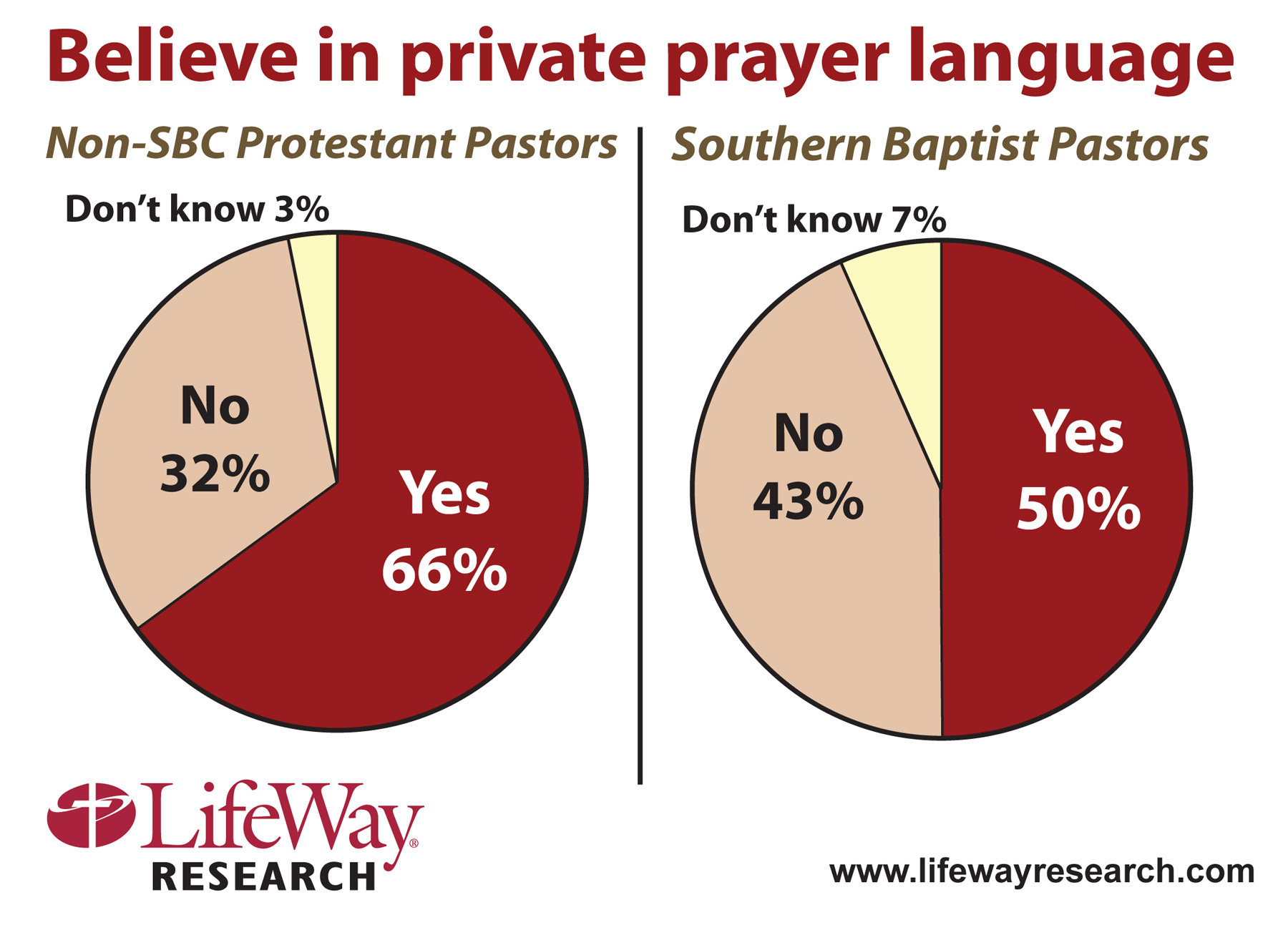


Let the spin begin ...
Thursday, May 31, 2007
Translating the Gospel
It's always good for some healthy reflection of what works and what doesn't. I can personally attest to why many of the churches in NC are doing so well as my dad served on the staff of many of them as the worship pastor. Those churches are people oriented, and they have a commitment to sound biblical preaching and making clear the whole gospel of Christ.
As for the churches in other states, I have some insight into them, as do you, due to my previous workings with contacting them, and they primarily fit the same billing.
The good thing about this list you've put up, is that it just goes to show that it doesn't matter if you're a "mega-church" or very traditional church (as some of them are), if you make the church about reaching people, and preach God's word accurately, and faithfully, GOD GROWS THE CHURCH!, ....but then again, it seems to me that He promised He'd do just that didn't He? :-) Good stuff man.
You've made some excellent points that I would like to elaborate upon if I may.
Yes, the Gospel of Christ is exactly it, but both in word and deed as Christ himself taught.
Yes, contemporary and traditional is all relative and can only be verified by the culture, personality and needs of a local church and the community it’s supposed to be serving. If the church is overwhelmingly traditional and only a few people want a contemporary-type church, then a contemporary church would be a horrible idea. Furthermore, if the community a church is supposed to be serving is contemporary and the church is traditional, generally speaking, such a church cannot expect to have much of an affect. But such would only be the “horrible” for the church, if that church is attempting to have an affect. If the church doesn’t want to serve, then witness and evangelize their community, there is no real need to explain the gospel to their community.
I noticed that Saddleback was not one of the churches listed
The form and method of communicating the Word of God is also important if not vital to the message itself.
Generally, a sermon screamed in anger is not as affective as a sermon spoken in love (again, generally speaking).
Preaching God’s Word accurately is also about expressing it clearly; hence, it’s all about translation.
The Hebrew Bible was translated into Greek and it was extremely effective in spreading the Word of God even among Gentiles.
The Bible as a whole was translated into Latin in order to communicate the Gospel in Europe.
The Roman Church held so much power over so many of the churches in Northern Africa, that they were able to prevent them from translating the Latin Bible into languages familiar to those people. Overtime, the gospel became foreign to the people of Northern Africa, and Islam became dominate.
The Roman Church continued to place the Latin Bible in prominence while the peoples of Europe began to speak non-Latin languages. Overtime, the gospel became almost as foreign to the people of Europe as those of Northern Africa. The people were ignorant and heresy spread thru the Roman Church unchecked.
However, the Renaissance brought a renewed interest in Hellenism and the Greek language. Wyclif was persecuted by the church for his English Bible translation as was Luther. But with Bibles being translated into common tongues and spread across Europe by Gutenberg’s printing press, the meaning of the Scriptures and the Word of God reached the common man.
Revival and reform followed.
In an increasingly un-churched and post-Christian world, we need to effectively communicate the Word of God both in word and action in a manner which the society can understand. We cannot afford to teach an unwilling and unsaved populace traditional Southern American Baptist culture as a means to communicate the Gospel. The Gospel is superior to Southern American Baptist culture and must come first.
Thus, if the community culture surrounding a church is traditional or the church has no interest in communicating the Gospel beyond their doors, tradition is the way to go. However, if we really want to see the Gospel transform people’s lives, if we really want to see Revival and Reform, if we really do not want to see America becoming another Palestine, Northern Africa, or Western Europe, people are going to have to abandon their selfish whims and comfort zones and sacrifice their cherished familiar for the salvation of the next generation.
As for the churches in other states, I have some insight into them, as do you, due to my previous workings with contacting them, and they primarily fit the same billing.
The good thing about this list you've put up, is that it just goes to show that it doesn't matter if you're a "mega-church" or very traditional church (as some of them are), if you make the church about reaching people, and preach God's word accurately, and faithfully, GOD GROWS THE CHURCH!, ....but then again, it seems to me that He promised He'd do just that didn't He? :-) Good stuff man.
You've made some excellent points that I would like to elaborate upon if I may.
Yes, the Gospel of Christ is exactly it, but both in word and deed as Christ himself taught.
Yes, contemporary and traditional is all relative and can only be verified by the culture, personality and needs of a local church and the community it’s supposed to be serving. If the church is overwhelmingly traditional and only a few people want a contemporary-type church, then a contemporary church would be a horrible idea. Furthermore, if the community a church is supposed to be serving is contemporary and the church is traditional, generally speaking, such a church cannot expect to have much of an affect. But such would only be the “horrible” for the church, if that church is attempting to have an affect. If the church doesn’t want to serve, then witness and evangelize their community, there is no real need to explain the gospel to their community.
I noticed that Saddleback was not one of the churches listed
The form and method of communicating the Word of God is also important if not vital to the message itself.
Generally, a sermon screamed in anger is not as affective as a sermon spoken in love (again, generally speaking).
Preaching God’s Word accurately is also about expressing it clearly; hence, it’s all about translation.
The Hebrew Bible was translated into Greek and it was extremely effective in spreading the Word of God even among Gentiles.
The Bible as a whole was translated into Latin in order to communicate the Gospel in Europe.
The Roman Church held so much power over so many of the churches in Northern Africa, that they were able to prevent them from translating the Latin Bible into languages familiar to those people. Overtime, the gospel became foreign to the people of Northern Africa, and Islam became dominate.
The Roman Church continued to place the Latin Bible in prominence while the peoples of Europe began to speak non-Latin languages. Overtime, the gospel became almost as foreign to the people of Europe as those of Northern Africa. The people were ignorant and heresy spread thru the Roman Church unchecked.
However, the Renaissance brought a renewed interest in Hellenism and the Greek language. Wyclif was persecuted by the church for his English Bible translation as was Luther. But with Bibles being translated into common tongues and spread across Europe by Gutenberg’s printing press, the meaning of the Scriptures and the Word of God reached the common man.
Revival and reform followed.
In an increasingly un-churched and post-Christian world, we need to effectively communicate the Word of God both in word and action in a manner which the society can understand. We cannot afford to teach an unwilling and unsaved populace traditional Southern American Baptist culture as a means to communicate the Gospel. The Gospel is superior to Southern American Baptist culture and must come first.
Thus, if the community culture surrounding a church is traditional or the church has no interest in communicating the Gospel beyond their doors, tradition is the way to go. However, if we really want to see the Gospel transform people’s lives, if we really want to see Revival and Reform, if we really do not want to see America becoming another Palestine, Northern Africa, or Western Europe, people are going to have to abandon their selfish whims and comfort zones and sacrifice their cherished familiar for the salvation of the next generation.
Thursday, May 24, 2007
It Was Good For Bach and Mozart ...
I’ve noticed that far too many critics of contemporary praise and worship music will dismiss such music as being far too repetitive. As someone who dislikes most of both traditional and contemporary Christian music, allow me to defend contemporary praise and worship music.
I suggest that you traditionalists read Psalms 136 and 150.
Also, I would recommend that you traditionalist critics of contemporary Christian music who argue that repetitive praise and worship songs are bad
Also the Baptist Hymnal standard song which continually repeats the word “Alleluia” as its lyrics.
Honestly, I do not know how you traditionalists can stand those old gospel hymns. The music and lyrics are so dull, somber and simplistic. It speaks to the world of a uncomplicated God, a creator with little imagination and an unsophisticated manner by which to worship him.
Do you not think that God deserves better worship music than Southern American gospel hymns? Or is any old music good enough so long as you like it?
Aren’t the classical pieces by Bach, Mozart and Handel better than those of George Beverly Shea, Cliff Barrow, and Bill Gaither? Of course it is. But if you don’t think it is right to give God your best then that is between you and hell.
Here’s another one:
Why do we in traditional churches sing 150 year old gospel hymns? Because people 150 years ago did not want to sing 200 year old songs.
Therefore, those of you in the traditionalist worship crowd who are mad that your musical movement is flailing and will ultimately go the way of the dodo should take comfort. In 20 to 30 years, today’s contemporary worship promoters will be just as mad that their traditionally “contemporary” music is flailing and will ultimately go the way of the dodo.
I suggest that you traditionalists read Psalms 136 and 150.
Also, I would recommend that you traditionalist critics of contemporary Christian music who argue that repetitive praise and worship songs are bad
Also the Baptist Hymnal standard song which continually repeats the word “Alleluia” as its lyrics.
Honestly, I do not know how you traditionalists can stand those old gospel hymns. The music and lyrics are so dull, somber and simplistic. It speaks to the world of a uncomplicated God, a creator with little imagination and an unsophisticated manner by which to worship him.
Do you not think that God deserves better worship music than Southern American gospel hymns? Or is any old music good enough so long as you like it?
Aren’t the classical pieces by Bach, Mozart and Handel better than those of George Beverly Shea, Cliff Barrow, and Bill Gaither? Of course it is. But if you don’t think it is right to give God your best then that is between you and hell.
Here’s another one:
Why do we in traditional churches sing 150 year old gospel hymns? Because people 150 years ago did not want to sing 200 year old songs.
Therefore, those of you in the traditionalist worship crowd who are mad that your musical movement is flailing and will ultimately go the way of the dodo should take comfort. In 20 to 30 years, today’s contemporary worship promoters will be just as mad that their traditionally “contemporary” music is flailing and will ultimately go the way of the dodo.
Thursday, May 17, 2007
"Welcome To My Life, Tattoo"
The other day while I was waiting in line at the Post Office to buy eighty 2 cent stamps, I observed a gruff and muscled man in front of me. He was wearing a tank top and sandals. While he had toe nails that resembled Fritos, it was the tattoo on his upper arm that sustained my attention.
His tattoo was a large depiction of the shaggy head of a panther. The design itself was of no great interest, expect that the panther’s nose was drawn around what looked like an indention in the man’s skin. As I studied the tattoo more closely, I discovered that it was apparently designed and drawn to hide a scar on the man’s upper arm.
The man had a tattoo applied to upper arm to hide a scar on his skin!
How brilliant! I must be quite honest; I have never heard of such a thing before. I’m actually surprised that I haven’t! The idea seems so logically simple.
I think I might start studying other tattoos when given the chance and see how many other people have had this idea.
His tattoo was a large depiction of the shaggy head of a panther. The design itself was of no great interest, expect that the panther’s nose was drawn around what looked like an indention in the man’s skin. As I studied the tattoo more closely, I discovered that it was apparently designed and drawn to hide a scar on the man’s upper arm.
The man had a tattoo applied to upper arm to hide a scar on his skin!
How brilliant! I must be quite honest; I have never heard of such a thing before. I’m actually surprised that I haven’t! The idea seems so logically simple.
I think I might start studying other tattoos when given the chance and see how many other people have had this idea.
Tuesday, May 15, 2007
Recommended Religious Reading List
XXXXX,
You asked a few weeks ago for a recommended religious reading list. Here's mine. I'll also post these on my blog. Thanks. PC
Dogmatics (vol. 1 and 2) – Emil Brunner
Mere Christianity – C. S. Lewis
Transforming Mission – David Bosch
Philosophical Fragments – Soren Kierkegaard
Message and Mission – Eugene Nida
Customs and Culture – Eugene Nida
Cost of Discipleship – Dietrich Bonhoeffer
Word of Truth – Dale Moody
Either/Or – Soren Kierkegaard
Nature and Destiny of Man – Reinhold Niebuhr
Understanding Genesis – Nahum Sarna
The Concept of Anxiety – Soren Kierkegaard
Concluding Unscientific Postscript - Soren Kierkegaard
Axioms of Religion – E.Y. Mullins
The Christian Religion in its Doctrinal Expression – E.Y. Mullins
The Sickness Unto Death – Soren Kierkegaard
On Being Christian – Hans Kung
The Baptist Heritage – Leon McBeth
Fear and Trembling – Soren Kierkegaard
Works of Love – Soren Kierkegaard
The Epistle to the Romans – Karl Barth
The Polarities of Human Existence in Biblical Perspective – Frank Stagg
New Testament Theology - Frank Stagg
The Book of Daniel (ABC) – Alexander A. Di Lella and Louis F. Hartman
I and Thou – Martin Buber
The Message of Genesis – Ralph Elliott
The Divine Imperative – Emil Brunner
The Mediator – Emil Brunner
The Theology of Hope – Jurgen Moltmann
A Literary Approach to the New Testament – John Paul Pritchard
Provocations: The Spiritual Writings of Soren Kierkegaard
Apostasy – Dale Moody
Sexual Ethics – Stanley Grenz
Christian Theology – Millard Erickson
The Book of J – Harold Bloom
Genesis: A Living Conversation – Bill Moyers
Christ and Culture and Culture – H. Richard Niebuhr
Communicating Christ Cross-Culturally – David Hesselgrave
Baptist Confessions of Faith – William Lumpkin
Here are some “religious” works of fiction. Not all “Christian” and not all explicitly “religious”:
Before the Law – Franz Kafka
Waiting for Godot – Samuel Beckett
The Chronicles of Narnia – C.S. Lewis
The Wasteland - T. S. Elliot
Meditation XVII - John Donne
The Second Coming – W.B. Yeats
Four Quartets - T. S. Elliot
The Brothers Karamazov - Dostoyevsky
The Divine Comedy – Alighieri Dante
Paradise Lost – John Milton
The Last Temptation - Nikos Kazantzakis
Moby Dick – Herman Melville
The Castle - Franz Kafka
The Trial – Franz Kafka
Crime and Punishment – Fyodor Dostoyevsky
You asked a few weeks ago for a recommended religious reading list. Here's mine. I'll also post these on my blog. Thanks. PC
Dogmatics (vol. 1 and 2) – Emil Brunner
Mere Christianity – C. S. Lewis
Transforming Mission – David Bosch
Philosophical Fragments – Soren Kierkegaard
Message and Mission – Eugene Nida
Customs and Culture – Eugene Nida
Cost of Discipleship – Dietrich Bonhoeffer
Word of Truth – Dale Moody
Either/Or – Soren Kierkegaard
Nature and Destiny of Man – Reinhold Niebuhr
Understanding Genesis – Nahum Sarna
The Concept of Anxiety – Soren Kierkegaard
Concluding Unscientific Postscript - Soren Kierkegaard
Axioms of Religion – E.Y. Mullins
The Christian Religion in its Doctrinal Expression – E.Y. Mullins
The Sickness Unto Death – Soren Kierkegaard
On Being Christian – Hans Kung
The Baptist Heritage – Leon McBeth
Fear and Trembling – Soren Kierkegaard
Works of Love – Soren Kierkegaard
The Epistle to the Romans – Karl Barth
The Polarities of Human Existence in Biblical Perspective – Frank Stagg
New Testament Theology - Frank Stagg
The Book of Daniel (ABC) – Alexander A. Di Lella and Louis F. Hartman
I and Thou – Martin Buber
The Message of Genesis – Ralph Elliott
The Divine Imperative – Emil Brunner
The Mediator – Emil Brunner
The Theology of Hope – Jurgen Moltmann
A Literary Approach to the New Testament – John Paul Pritchard
Provocations: The Spiritual Writings of Soren Kierkegaard
Apostasy – Dale Moody
Sexual Ethics – Stanley Grenz
Christian Theology – Millard Erickson
The Book of J – Harold Bloom
Genesis: A Living Conversation – Bill Moyers
Christ and Culture and Culture – H. Richard Niebuhr
Communicating Christ Cross-Culturally – David Hesselgrave
Baptist Confessions of Faith – William Lumpkin
Here are some “religious” works of fiction. Not all “Christian” and not all explicitly “religious”:
Before the Law – Franz Kafka
Waiting for Godot – Samuel Beckett
The Chronicles of Narnia – C.S. Lewis
The Wasteland - T. S. Elliot
Meditation XVII - John Donne
The Second Coming – W.B. Yeats
Four Quartets - T. S. Elliot
The Brothers Karamazov - Dostoyevsky
The Divine Comedy – Alighieri Dante
Paradise Lost – John Milton
The Last Temptation - Nikos Kazantzakis
Moby Dick – Herman Melville
The Castle - Franz Kafka
The Trial – Franz Kafka
Crime and Punishment – Fyodor Dostoyevsky
Head Coverings During Prayer: Applying 1 Corinthian 11:4 at Graduation
During my graduation rehearsal, we were told that during prayers the men must take off their hats while women were to keep their hats on. [pardon the preposition]
I myself think that such a by-gone tradition and unscriptural sexist discrimination is foolish. I considered keeping my own hat on in solidarity with the female ministers in my class. However, after quick consideration, I decided to honor these two “traditions” out of due respect of my position as a guest at this church (Travis Avenue Baptist).
Oddly enough, a lovely Korean lady sitting near me asked me why she and other women must keep their hats on while the men were required to take their hats off during prayers. I explained to her that this practice is due to the traditional misinterpretation of 1 Corinthians 11.
“Every man praying or prophesying, having his head covered, dishonoureth his head. But every woman that prayeth or prophesieth with her head uncovered dishonoureth her head: for that is even all one as if she were shaven.” (1 Corinthian 11:4f.)
Incidentally, 1 Corinthians is probably the most ironically misinterpreted book of the NT. I say “ironically” because there are several passages in this book so misinterpreted by evangelicals that they end up practicing these teachings in the very manner against which Paul teaches (i.e., “speaking in tongues”, women and authority, Christian liberty, communion and divisions, etc.) How odd.
But her question struck a thought.
“Every man praying or prophesying, having his head covered, dishonoureth his head.” (1 Corinthian 11:4)
“Having his head covered?” Are we to take this commandment by God thru Paul literally? If that be the case, then shouldn’t men take off their toupees and hairpieces when praying at church? That’s what the Bible says, right?
Of course, we take the English word “covered” to refer to “hats” of some sort and not simply “covering”.
But if toupees and hairpieces were referred to as “hair hats” (ala the Seinfeld episode titled “The Beard”) would we then deem toupees to be hats and thus a covering which 1 Corinthians prohibits?
I do not know. I suspect it depends upon who in power among those who decide how we are to interpret Scripture has a toupee or not.
I myself think that such a by-gone tradition and unscriptural sexist discrimination is foolish. I considered keeping my own hat on in solidarity with the female ministers in my class. However, after quick consideration, I decided to honor these two “traditions” out of due respect of my position as a guest at this church (Travis Avenue Baptist).
Oddly enough, a lovely Korean lady sitting near me asked me why she and other women must keep their hats on while the men were required to take their hats off during prayers. I explained to her that this practice is due to the traditional misinterpretation of 1 Corinthians 11.
“Every man praying or prophesying, having his head covered, dishonoureth his head. But every woman that prayeth or prophesieth with her head uncovered dishonoureth her head: for that is even all one as if she were shaven.” (1 Corinthian 11:4f.)
Incidentally, 1 Corinthians is probably the most ironically misinterpreted book of the NT. I say “ironically” because there are several passages in this book so misinterpreted by evangelicals that they end up practicing these teachings in the very manner against which Paul teaches (i.e., “speaking in tongues”, women and authority, Christian liberty, communion and divisions, etc.) How odd.
But her question struck a thought.
“Every man praying or prophesying, having his head covered, dishonoureth his head.” (1 Corinthian 11:4)
“Having his head covered?” Are we to take this commandment by God thru Paul literally? If that be the case, then shouldn’t men take off their toupees and hairpieces when praying at church? That’s what the Bible says, right?
Of course, we take the English word “covered” to refer to “hats” of some sort and not simply “covering”.
But if toupees and hairpieces were referred to as “hair hats” (ala the Seinfeld episode titled “The Beard”) would we then deem toupees to be hats and thus a covering which 1 Corinthians prohibits?
I do not know. I suspect it depends upon who in power among those who decide how we are to interpret Scripture has a toupee or not.
Friday, May 04, 2007
So Far ... What is it about Mormonism that prevents its followers from having salvation in Christ?
1) I have been reading the numerous books written by evangelicals about Mormonism. While these books are mentioning the various bad teachings of the Mormon Church, so far I am not reading any author that states why Mormons are not in a saving relationship with Christ.
2) Many of the apologetic books that deal with the false teachings of Mormonism are somewhat selective in their identification. Typically, the authors will take a fundamental Mormon teaching which is taken from the Biblical Scriptures and then attempt to explain why this teaching is taken in the wrong way by Mormons. The problem with this approach is that the authors present their case on the basis of individual interpretations of the Christian Faith which may or may not represent the teachings of the entire community. This is sort of like accusing all of today’s Southern Baptists of Landmarkism based upon the teachings of James Robinson Graves.
That such a problem of interpretation exists among many apologetic authors attempting to explain and repute Mormonism is evident in the frequent references to that most contemporary ignorance to such teachings. The apologetic authors often find modern and contemporary leaders of the Mormon Church who are frequently embarrassed and bewildered by the teachings of Smith and other Mormon Church founders. Thus, these apologetic authors readily admit that most members of the Mormon Church do not know of these old teachings. Indeed, these apologetic authors argue that most Mormons hold to the orthodox Christian teachings on most of the fundamentals and would be shocked to know that Joseph Smith and others taught differently than what they now believe.
So my question is this: if the contemporary leaders hold to the orthodox teachings and the vast majority of the Mormon Church members hold to these teachings, isn’t then the current teachings of the Mormon Church different from what they are currently being accused?
2) Many of the false teachings of the Mormon Church that derive from their misinterpretation of Scripture are false teachings that I see all the time in conservative evangelical churches. Usually, such misinterpretations stem from an overly-literal hermeneutic. No real surprise I suppose. There is a distinctly American form of religion that developed in the 19th century with highly eschatological and separatist tendencies. Such groups and movements include Fundamentalism, Landmarkism, Pentacostalism, Mormonism, Jehovah Witness, Campbellites, Millerites and Dispensationalism. Of course, many of these movements have distanced themselves from the beliefs of their founders. We shouldn’t assume that the 19th century views of William Miller are still the 21st century views of 7th Day Adventists. How would we like it if other believers assumed that today’s Southern Baptists affirm slavery simply because our denomination began over that issue?
Interestingly, one great commonality among these 19th century American apocalyptic separatist Christian traditions was an overly-literal hermeneutic. Indeed, it was from this literal hermeneutic that their distinctive beliefs grew and which enabled them to separate themselves from other Christian traditions.
So I do find it interesting that so many false Mormon doctrines are not only held here and there by various “acceptable” conservative Christian traditions but that these false teachings derive from taking the Bible literally in places where they probably should not. In essence, they are often heretical by believing the Bible literally. Too much fun.
These are just some of my observations. No finality to any of them. I have not reached any decision about which Mormon beliefs separate them from salvation. I have been reading up on their beliefs and practices concerning “salvation by grace through faith in Jesus Christ” and both Mormon and non-Mormon interpretations of what Mormons believe about this doctrine. We shall see.
2) Many of the apologetic books that deal with the false teachings of Mormonism are somewhat selective in their identification. Typically, the authors will take a fundamental Mormon teaching which is taken from the Biblical Scriptures and then attempt to explain why this teaching is taken in the wrong way by Mormons. The problem with this approach is that the authors present their case on the basis of individual interpretations of the Christian Faith which may or may not represent the teachings of the entire community. This is sort of like accusing all of today’s Southern Baptists of Landmarkism based upon the teachings of James Robinson Graves.
That such a problem of interpretation exists among many apologetic authors attempting to explain and repute Mormonism is evident in the frequent references to that most contemporary ignorance to such teachings. The apologetic authors often find modern and contemporary leaders of the Mormon Church who are frequently embarrassed and bewildered by the teachings of Smith and other Mormon Church founders. Thus, these apologetic authors readily admit that most members of the Mormon Church do not know of these old teachings. Indeed, these apologetic authors argue that most Mormons hold to the orthodox Christian teachings on most of the fundamentals and would be shocked to know that Joseph Smith and others taught differently than what they now believe.
So my question is this: if the contemporary leaders hold to the orthodox teachings and the vast majority of the Mormon Church members hold to these teachings, isn’t then the current teachings of the Mormon Church different from what they are currently being accused?
2) Many of the false teachings of the Mormon Church that derive from their misinterpretation of Scripture are false teachings that I see all the time in conservative evangelical churches. Usually, such misinterpretations stem from an overly-literal hermeneutic. No real surprise I suppose. There is a distinctly American form of religion that developed in the 19th century with highly eschatological and separatist tendencies. Such groups and movements include Fundamentalism, Landmarkism, Pentacostalism, Mormonism, Jehovah Witness, Campbellites, Millerites and Dispensationalism. Of course, many of these movements have distanced themselves from the beliefs of their founders. We shouldn’t assume that the 19th century views of William Miller are still the 21st century views of 7th Day Adventists. How would we like it if other believers assumed that today’s Southern Baptists affirm slavery simply because our denomination began over that issue?
Interestingly, one great commonality among these 19th century American apocalyptic separatist Christian traditions was an overly-literal hermeneutic. Indeed, it was from this literal hermeneutic that their distinctive beliefs grew and which enabled them to separate themselves from other Christian traditions.
So I do find it interesting that so many false Mormon doctrines are not only held here and there by various “acceptable” conservative Christian traditions but that these false teachings derive from taking the Bible literally in places where they probably should not. In essence, they are often heretical by believing the Bible literally. Too much fun.
These are just some of my observations. No finality to any of them. I have not reached any decision about which Mormon beliefs separate them from salvation. I have been reading up on their beliefs and practices concerning “salvation by grace through faith in Jesus Christ” and both Mormon and non-Mormon interpretations of what Mormons believe about this doctrine. We shall see.
Tuesday, May 01, 2007
What is it about Mormonism that prevents its followers from having salvation in Christ?
Last night I watched a little bit of the PBS documentary on Mormonism. I say “little” because the amount of time I took to watch television last night amounted to about 20 minutes.
A thought came to me later in the evening: what is it about Mormonism that prevents its followers from having salvation in Christ?
This is not a trick question. It is sincere. I myself really do not know; I am quite ignorant of the subject. When one is an evangelical child, one automatically accepts the proposition that Mormons are not true believers and are thus not truly saved. One accepts this without question but, as time and curiosity progresses, one begins to question this assumption and seeks proof. “Mormons claim to be Christians and followers of God in Christ. Why are they not? Prove it.”
So if we as orthodox Christians believe that Mormons are not truly saved, why do we say this? What reason? I want to know.
Allow me to reject a few possible replies as untenable:
1) Mormons doctrines are heretical.
This is undoubtedly true but that in of itself does constitute a separation from salvation. Every Christian group has some false teachings, as does every person. Who then could be saved? Therefore, the general principle of having heretical views must be specific for particular teachings in order to objectively verifiable. And Mormons may have a specific teaching or more that separates them from salvation. But what is it?
2) Mormons use a false scripture along with the orthodox Bible.
Again, this is undoubtedly true. However, this again in of itself does not constitute a separation from salvation. Roman Catholics hold the Apocryphal writings to be Scriptural. The overwhelming majority of Orthodox Christians hold John 7:53-8:11 and Mark 16:9-20 to be authoritative Scripture. However, both of these passages are in none of the earliest manuscripts. This is a fact which evangelical scholars know to be true. These passages are additions to the Scriptures and are neither authoritative nor binding upon the orthodox believer. Yet, most people mistakenly hold these passages to be Scripture. Therefore, the fact that Mormons use a false scripture along with the orthodox Bible does not automatically constitute a separation from salvation.
3) The lofty reverence given to Joseph Smith and his teachings.
A few points:
A) Joseph Smith is considered a prophet but he is not worshipped.
B) That Mormons follow his false teachings does not necessarily constitute a separation from salvation. Most Christians follow one or more of the false teachings of Augustine, Anselm, Abelard, Aquinas, Luther, Calvin, Zwingli, Edwards, Schleiermacher, Graves and Norris.
C) Along with this last point, evangelicals will often attempt to discredit Mormonism by finding false statements made by its leaders. We must be careful about this; the statements of leaders do not always reflect the views of followers. If that were so, then we would not have needed a Conservative Resurgence. Indeed, John Calvin held to infant baptism but this does not mean that all the professors at Southern Seminary are apostates! We can go through our own SBC records and find numerous sayings made by convention leaders and professors that are absurdly false (especially in the last 25 years). Indeed, there are many Fundamentalist Baptist groups who believe that TODAY’S SBC and its leadership are apostate and going to hell. And let’s not even get started on Bob Jones University.
Thus, we need to be careful about the arguments we make if such arguments can be made.
A place I would begin is a general summary of “Mormon Fundamentals”, comparing them with whatever Christian fundamentals exist.
Also, I think the area of primary focus needs to be on the central Christian teaching (so says I): “salvation by grace through faith in Jesus Christ.”
Again, I am only interested in the subject of the salvation of Mormons and not their false beliefs unless such beliefs are responsible for their separation from salvation in Jesus Christ.
A thought came to me later in the evening: what is it about Mormonism that prevents its followers from having salvation in Christ?
This is not a trick question. It is sincere. I myself really do not know; I am quite ignorant of the subject. When one is an evangelical child, one automatically accepts the proposition that Mormons are not true believers and are thus not truly saved. One accepts this without question but, as time and curiosity progresses, one begins to question this assumption and seeks proof. “Mormons claim to be Christians and followers of God in Christ. Why are they not? Prove it.”
So if we as orthodox Christians believe that Mormons are not truly saved, why do we say this? What reason? I want to know.
Allow me to reject a few possible replies as untenable:
1) Mormons doctrines are heretical.
This is undoubtedly true but that in of itself does constitute a separation from salvation. Every Christian group has some false teachings, as does every person. Who then could be saved? Therefore, the general principle of having heretical views must be specific for particular teachings in order to objectively verifiable. And Mormons may have a specific teaching or more that separates them from salvation. But what is it?
2) Mormons use a false scripture along with the orthodox Bible.
Again, this is undoubtedly true. However, this again in of itself does not constitute a separation from salvation. Roman Catholics hold the Apocryphal writings to be Scriptural. The overwhelming majority of Orthodox Christians hold John 7:53-8:11 and Mark 16:9-20 to be authoritative Scripture. However, both of these passages are in none of the earliest manuscripts. This is a fact which evangelical scholars know to be true. These passages are additions to the Scriptures and are neither authoritative nor binding upon the orthodox believer. Yet, most people mistakenly hold these passages to be Scripture. Therefore, the fact that Mormons use a false scripture along with the orthodox Bible does not automatically constitute a separation from salvation.
3) The lofty reverence given to Joseph Smith and his teachings.
A few points:
A) Joseph Smith is considered a prophet but he is not worshipped.
B) That Mormons follow his false teachings does not necessarily constitute a separation from salvation. Most Christians follow one or more of the false teachings of Augustine, Anselm, Abelard, Aquinas, Luther, Calvin, Zwingli, Edwards, Schleiermacher, Graves and Norris.
C) Along with this last point, evangelicals will often attempt to discredit Mormonism by finding false statements made by its leaders. We must be careful about this; the statements of leaders do not always reflect the views of followers. If that were so, then we would not have needed a Conservative Resurgence. Indeed, John Calvin held to infant baptism but this does not mean that all the professors at Southern Seminary are apostates! We can go through our own SBC records and find numerous sayings made by convention leaders and professors that are absurdly false (especially in the last 25 years). Indeed, there are many Fundamentalist Baptist groups who believe that TODAY’S SBC and its leadership are apostate and going to hell. And let’s not even get started on Bob Jones University.
Thus, we need to be careful about the arguments we make if such arguments can be made.
A place I would begin is a general summary of “Mormon Fundamentals”, comparing them with whatever Christian fundamentals exist.
Also, I think the area of primary focus needs to be on the central Christian teaching (so says I): “salvation by grace through faith in Jesus Christ.”
Again, I am only interested in the subject of the salvation of Mormons and not their false beliefs unless such beliefs are responsible for their separation from salvation in Jesus Christ.
Thursday, April 26, 2007
FIRST-PERSON: Are God & Allah the same? [Updated with commentary]
Posted on Apr 23, 2007 | by Emir Caner
With commentary
FORT WORTH, Texas (BP)--In some far-flung field around the world a Southern Baptist missionary enters a territory which has remained hostile to the Gospel for some time. Upon entering the mountainous village, he is able to speak to some of the villagers about eternal matters. They are uninhibited to speak about their faith, although reticent to accept any other opinion, and this missionary quickly gains a cursory understanding of their god. He is an all-powerful being who blesses both the just and the unjust. He reveals himself through miracles. Additionally, these villagers believe that there is no forgiveness of sin without the shedding of blood.
Ah, well this proves that their god is not the Christian god because Yahweh doesn’t need the shedding of blood to forgive sin. I certainly wouldn’t want to worship a god who cannot forgive sins without reparations. I myself do not need reparations to forgive others. I forgive others because I love them and not because I have punished someone.
In fact, these villagers believe that their god has a son and that this son was once dead and now has come to life! Now, can this missionary then assume that the god the villagers are describing, due to so many similar characteristics, is the same God the Scripture reveals?
If your answer is yes, you have fallen prey to a tactic the devil has used since the Fall in the Garden of Eden.
The devil (or the Satan) was not in Eden.
The devil, the best counterfeiter in history, plays upon the attributes of God and places them upon another, even himself.
Yes, but just because the Satan can do this doesn’t always mean that he IS doing this in such a circumstance. Man is quite capable of doing this on his or herself, without the assistance of the Satan. ... Do evangelicals still get upset when someone refers to the Satan by using definite article “the”?
Ironically, the situation above is not foreign to the Scripture, for Elijah is that missionary who found himself in a strikingly similar situation in 1 Kings 18:20-40.
Also, recall when Aaron made a golden calf and told the Hebrews, “These be thy gods, O Israel, which brought thee up out of the land of Egypt.” (Exod 32:4)
I actually read some select chapters out of C.S. Lewis’s The Last Battle this past weekend. There is a great chapter where Shift the ape convinces so many Narnians that Aslan is also known as Calormen god, Tash. Thus they begin to refer to them as Tashlan. Nice illustration of syncretism. ... Of course, while Aslan is proven to not be Tash and the latter is proven to be a demonic creature, Aslan states that those who worshipped Tash faithfully were actually worshipping Aslan faithfully though they did not know it. This is probably the most controversial part of the series but few ever mention it.
The Jewish people had fallen into idolatry, specifically Baal worship. Although Baal worship differed regionally, Elijah came across the form of Baal worship which believed that Baal is the son of El, the most high god.
Ah, yes, El Elyon – the god worshipped by Melchizedek.
Baal was once dead, but like the fall harvest, has come back to life. Baal required a blood sacrifice for appeasement to El, albeit the sacrifice is not of Baal himself but of a first-born son of each family.
Yes, which is another good reason why God did not require such a sacrifice of his son. Too many of us confuse pagan sacrifice and the sacrifice offered to and from Yahweh.
Baal was all-powerful and could be seen in miracles such as raining down fire. Yet, Baal was not mistaken as Jehovah. Elijah rhetorically asks the Israelites who are worshipping a false god, "How long will you falter between two opinions? If the Lord is God follow him; but if Baal, follow him" (1 Kings 18:21).
Today, similar debate has revolved around the two largest faiths in the world, Islam and Christianity, and whether the god of the Koran is the God of the Bible. Simply put, the god of Muhammad is not the Father of Jesus. The subject in its essence is not a linguistic issue, but a theological matter with eternal ramifications. To say that since Allah is Arabic for God and YHWH is Hebrew for God, Christians and Muslims worship the same God is beyond naïve –- it is blasphemous.
Yahweh is not Hebrew for “god”. The Hebrew for “god” is el or elohiym.
Hmm, do Mormons and Southern Baptists worship the same god? Do Christians and Jews worship the same god?
When Elijah challenged his fellow Jews to follow the one true God, he did so without regard to linguistics. Indeed, the etymology of Baal is derived from the root word for Lord or Master. If the matter at hand were merely about words and similar nomenclature, Elijah's statement would make absolutely no sense. Would the Israelites not be worshipping the same god as their forefathers since they have a title similar to that of their forefathers? Would Elijah not owe an unqualified apology to the prophets of Baal for assuming their worship was a façade and their god nonexistent? How could there even be such a theological animal as a "false god" if the word "god" is used in conversation? And for those who argue linguistically, would they be comfortable praying to Baal today since it is only another word for Lord?
Baal, El, Elohiym, El Elyon are all derived from the same Semitic word el, which means “god”.
As someone who came out of a Sunni Muslim background, I can personally attest that I rejected God as Father (surah 5:18), Jesus Christ as the Son of God (surah 5:116; 19:88), and the very person of the Holy Spirit (surah 70:4).
Which is why Sunnis who reject Christ will not be saved.
What part of the Triune God did I understand? I was an idolater, plain and simple, and the vacuity in my prayers only proved that point. Like the Israelites who worshipped Baal, I know too well the great pain of praying to a non-existent god. As 1 Kings 18:29 describes, "There was no voice; no one answered, no one paid attention." To argue, then, that I was worshipping the true God, just inadequately or incompletely, would have been to place false light upon my total darkness.
Jews. Look at the Jews. What god to they now worship? Look at the Jews during the first century. They prayed to Yahweh but rejected Yahweh’s son. What God were they then worshipping?
My Muslim mind would have interpreted such folly as insisting that Muhammad did receive at least some of his revelation from the one, true God -- that in some ways he was a true prophet.
There is a difference in receiving revelation from God and getting information of the revelation recorded in Scripture.
Again, the Jews have the OT which they received from Yahweh, but they reject his Son.
This is not an argument which denies that God is sovereign over Muhammad and all followers of Islam. But as Timothy George noted in a recent Christianity Today article, "No devout Muslim can call the God of Muhammad 'Father,' for this, to their mind, would compromise divine transcendence. But no faithful Christian can refuse to confess, with joy and confidence, 'I believe in God the Father ... Almighty!'
Again, Jews refer to Christ as “Father” even though they reject his Son.
Apart from the Incarnation and the Trinity, it is possible to know that God is, but not who God is." Even modern Muslim apologists recognize the difficulty in arguing that Christians worship the same god as Muslims. In a recent editorial in the PakTribune (Pakistan News Service), Ahmer Muzammil asserted, "I believe that whoever believes in one Allah (God) without any partners, sons, daughters or incarnations, whether they are Christians, Jews, Muslims, or whoever they might be, they all believe in the same Allah (GOD) that we do and that Jesus, Moses, Adam, Noah, and Mohammad called masses to the same GOD." The latter part of the quote, attributing Islamic devotion to Old Testament prophets, is key to understanding why the Koran states, "We believe in the revelation which has come down to us and in that which came down to you; Our God and your God is one; and it is to Him we bow (in Islam)" (surah 29:46). Muslims do not believe the God of the Old Testament, especially as seen in the Major and Minor Prophets, is their god since the Old Testament is a corrupted collection (surah 3:78) which fails to clarify that Abraham, Moses, and the other prophets were actually Muslims. Islam, in denying the revelation, denies the Revelator.
Sort of like how Peter and Paul were Roman Catholics?
Yes, Muslims do not “believe” in the God of the OT if we use “believe” to mean “saving faith”. While they may have cognitive belief in the God of the OT and worship him, since they reject the Son of the God of the OT, they do not have the belief that saves. If they did have the belief that saves they would believe in the Son. Everyone who has faith in the Father has faith in the Son. All who have faith in the Son already has faith in the Father.
The Koran further substantiates the claim that Christians do not worship the same god as Muslims. Surah 5:72 denounces partnering "other gods with Allah," and warns those who do so, "Allah will forbid him the Garden, and the Fire will be his abode."
Jews often say that Christians do not worship the god of the OT. Are they correct?
Surah 112:3, perhaps the central passage in the entire discussion, explicitly divorces Allah from the Christian God, explaining, "He begets not, nor is He begotten; and there is none like unto Him." Ultimately, Allah "forgives not (the sin of) joining other gods with Him" (4:116).
I’m reminded of the “Creationist” argument which states, “Christians should not believe what Atheistic Evolutionists say except when they say that evolution proves that there is no God. THAT is something that they say that you can believe!”
It is clear, then, that according to Islam Peter committed this heinous sin when he publicly proclaimed, "You are the Christ, the Son of the living God" (Matthew 16:16). The church itself is built upon this confession of faith in the Lord Jesus Christ, indeed, in the very character of Jesus Christ as the Son of God. To remove Him from the Godhead would be the death knell of the church, the end of Christianity. "There is no other foundation that anyone can lay than that which is laid, which is Jesus Christ" (1 Corinthians 3:11).
The rejection of Christ is why both Judaism and Islam are false systems of belief. This and not their worship of God.
Rejecting each person of the Trinity, the God of the Old Testament and New Testament is replaced by a figment of Muhammad's imagination, a god that beyond the somewhat similar characteristics of monotheism and transcendence resembles only remotely the God of the Scriptures. It behooves us as Southern Baptists to stand unwaveringly against the ecumenists and syncretists who try to convince us that Muslims and Christians worship the same god.
Again, he has not proven such. However, as I have said, if it was true that “Muslims and Christians worship the same god”, it would not be of any significance.
When Baptist scholars like Charles Kimball state, "The name for God in Islam, in Arabic, is Allah. This is not another god. This is the God. It's the same God that Jews and Christians are talking about," Southern Baptists must ardently stand against such theological heresy.
It’s not heresy.
For the sake of ensuring that the Gospel is preached faithfully and biblically, it is imperative that Southern Baptist leadership stand united on this crucial and non-negotiable issue. While Kimball and other prominent Baptists are creating confusion with a corrupt notion of the One True God, SBC leaders should draw a line of separation from them by boldly affirming that He is Father, Son and Holy Spirit, and rejecting the grave theological error that others are promoting.
Yes, but saying that “God is Father, Son and Holy Spirit” is not a refutation of the argument that Jews, Christians and Muslims worship the same God.
Since an assent of the god of Islam is ultimately a rejection of the Triune God, any such person who holds to such aberrant views should have the integrity to resign from any position of leadership held within the Southern Baptist Convention.
This is not a logical argument. Regardless, I’m not going to assent to an aberrant argument simply because I agree with the position that followers of Mohammed are not in a saving relationship with God. My agreement of this position does not chain me to particular arguments or even to any person or people and their movements simply because we agree on a particular truth.
This is what I hate most about politics: the ever-present tendency to adopt popular opinions, people and movements (regardless of their merit) in order to support a particular, common agenda. I desire far more freedom to pursue the truth than politics generally allows.
To equate the god of Islam with the God of the Bible is to reject the God described in the Baptist Faith and Message, the doctrinal statement which Southern Baptists have accepted for more than eight decades as a confessional statement ensuring theological accountability in our convention. Evidence strongly suggests that the vast majority of Southern Baptists uphold the distinction between the god of Islam and the God of the Scripture.
No comment.
In a recent survey, it was stated that 79 percent of evangelicals do not believe Muslims and Christians worship the same god. If that is the case within evangelicalism, it is certain that the percentage of Southern Baptists, more conservative than evangelicals at large, reject this belief in even greater numbers. Let's reassure Southern Baptists that what they believe is not in vain, that without Christ, religions and their gods are false.
I strongly agree. Religions without Christ are false. However, this is not the argument being made by Dr. Caner. If it was, then I would probably not need to challenge it (though I might if he was articulating it incorrectly).
Now here is the question which only one evangelical SBC person so far has been willing to answer: “do Jews and Christians worship the same God?”
The only reason this one person did so was because I left him no other option than to answer it or walk away. I told him that I admired his courage and I did!
Our voices must be heard on the issue or else our zeal for the lost will diminish and the clarity of the Gospel will be muddled. I pray our response to the situation will be vastly different from that of the Israelites who, when confronted with this issue, "answered [Elijah] not a word" (1 Kings 18:21b). This hour must be one of courage and not cowardice, for if the doctrine of God is compromised, other crucial doctrines will soon fall to the ecumenists as well. Truth is immortal.
Let it be known that I am neither challenging nor reinforcing the belief that Allah is or is not Yahweh. I’m only challenging the argument being made. This should be evident from the fact that I explicitly state that followers of Mohammed who reject Christ are not in a saving relationship with God. I need to say this because too many people assume that if one challenges an argument for a particular position, the one challenging is doing so to reject the position. This is not the case at all.
My frequent challenges of this particular line or argumentation are designed to support the centrality of Christ in process of salvation. After all, my theology is Christo-centric. Worshipping God (either as Yahweh or Allah) means practically little without Christ. Hence, my frequent references to Judaism.
Dr. Caner’s is quite rightly trying to establish the truth that followers of Mohammed are not in a saving relationship with God. This is true. However, the line of argument he has chosen to follow is that followers of Mohammed are not in a saving relationship with God because Allah and Yahweh are not the same god. This argument is both unnecessary and ill-effective. In fact, it appears to be counter productive. Dr. Caner comes off as saying that if Allah and Yahweh were on and the same god, then Muslims would be saved. This is not the case. My perennial example is that of Jews who do worship Yahweh but do not accept the Son of Yahweh. Are they in a saving relationship with God because they worship him? No, they are not.
Truly, Allah is a word that simply means “god”. It means “god” just as el meant “god” in the ancient world. Again, Baal, El, Elohiym, El Elyon and Allah are all derived from the same Semitic word el, which means “god”.
As I have said on other occasions, there are Middle Eastern Christian believers from Islamic backgrounds who follow Jesus Christ and not Mohammed but who nevertheless refer to Yahweh as Allah. They do so because if an Arabic speaking person wants to say the word “god” in their language they must say Allah. For example, let us say that a English-speaking follower of Wicca refers to some god such as the Moon and refers to it as a “god”. If this person is converted to the Christian Faith and begins to follow Christ he or she will still use the word “god” to refer to Yahweh. Their continued use of the word “god” does not imply syncretism but their understanding that they now follow the TRUE god. The same is true with the use of Allah.
Jews, Christians and Muslims all identify their respective god as the God who acted in history as recorded in the OT. Who is right?
See also:
Worshipping God in Vain
The God of Mohammed in Greensboro
CULTURE DIGEST: Saudi Arabian textbooks still promote hatred, religious discord (with Discussions about Islam and ... well, Masons really)
With commentary
FORT WORTH, Texas (BP)--In some far-flung field around the world a Southern Baptist missionary enters a territory which has remained hostile to the Gospel for some time. Upon entering the mountainous village, he is able to speak to some of the villagers about eternal matters. They are uninhibited to speak about their faith, although reticent to accept any other opinion, and this missionary quickly gains a cursory understanding of their god. He is an all-powerful being who blesses both the just and the unjust. He reveals himself through miracles. Additionally, these villagers believe that there is no forgiveness of sin without the shedding of blood.
Ah, well this proves that their god is not the Christian god because Yahweh doesn’t need the shedding of blood to forgive sin. I certainly wouldn’t want to worship a god who cannot forgive sins without reparations. I myself do not need reparations to forgive others. I forgive others because I love them and not because I have punished someone.
In fact, these villagers believe that their god has a son and that this son was once dead and now has come to life! Now, can this missionary then assume that the god the villagers are describing, due to so many similar characteristics, is the same God the Scripture reveals?
If your answer is yes, you have fallen prey to a tactic the devil has used since the Fall in the Garden of Eden.
The devil (or the Satan) was not in Eden.
The devil, the best counterfeiter in history, plays upon the attributes of God and places them upon another, even himself.
Yes, but just because the Satan can do this doesn’t always mean that he IS doing this in such a circumstance. Man is quite capable of doing this on his or herself, without the assistance of the Satan. ... Do evangelicals still get upset when someone refers to the Satan by using definite article “the”?
Ironically, the situation above is not foreign to the Scripture, for Elijah is that missionary who found himself in a strikingly similar situation in 1 Kings 18:20-40.
Also, recall when Aaron made a golden calf and told the Hebrews, “These be thy gods, O Israel, which brought thee up out of the land of Egypt.” (Exod 32:4)
I actually read some select chapters out of C.S. Lewis’s The Last Battle this past weekend. There is a great chapter where Shift the ape convinces so many Narnians that Aslan is also known as Calormen god, Tash. Thus they begin to refer to them as Tashlan. Nice illustration of syncretism. ... Of course, while Aslan is proven to not be Tash and the latter is proven to be a demonic creature, Aslan states that those who worshipped Tash faithfully were actually worshipping Aslan faithfully though they did not know it. This is probably the most controversial part of the series but few ever mention it.
The Jewish people had fallen into idolatry, specifically Baal worship. Although Baal worship differed regionally, Elijah came across the form of Baal worship which believed that Baal is the son of El, the most high god.
Ah, yes, El Elyon – the god worshipped by Melchizedek.
Baal was once dead, but like the fall harvest, has come back to life. Baal required a blood sacrifice for appeasement to El, albeit the sacrifice is not of Baal himself but of a first-born son of each family.
Yes, which is another good reason why God did not require such a sacrifice of his son. Too many of us confuse pagan sacrifice and the sacrifice offered to and from Yahweh.
Baal was all-powerful and could be seen in miracles such as raining down fire. Yet, Baal was not mistaken as Jehovah. Elijah rhetorically asks the Israelites who are worshipping a false god, "How long will you falter between two opinions? If the Lord is God follow him; but if Baal, follow him" (1 Kings 18:21).
Today, similar debate has revolved around the two largest faiths in the world, Islam and Christianity, and whether the god of the Koran is the God of the Bible. Simply put, the god of Muhammad is not the Father of Jesus. The subject in its essence is not a linguistic issue, but a theological matter with eternal ramifications. To say that since Allah is Arabic for God and YHWH is Hebrew for God, Christians and Muslims worship the same God is beyond naïve –- it is blasphemous.
Yahweh is not Hebrew for “god”. The Hebrew for “god” is el or elohiym.
Hmm, do Mormons and Southern Baptists worship the same god? Do Christians and Jews worship the same god?
When Elijah challenged his fellow Jews to follow the one true God, he did so without regard to linguistics. Indeed, the etymology of Baal is derived from the root word for Lord or Master. If the matter at hand were merely about words and similar nomenclature, Elijah's statement would make absolutely no sense. Would the Israelites not be worshipping the same god as their forefathers since they have a title similar to that of their forefathers? Would Elijah not owe an unqualified apology to the prophets of Baal for assuming their worship was a façade and their god nonexistent? How could there even be such a theological animal as a "false god" if the word "god" is used in conversation? And for those who argue linguistically, would they be comfortable praying to Baal today since it is only another word for Lord?
Baal, El, Elohiym, El Elyon are all derived from the same Semitic word el, which means “god”.
As someone who came out of a Sunni Muslim background, I can personally attest that I rejected God as Father (surah 5:18), Jesus Christ as the Son of God (surah 5:116; 19:88), and the very person of the Holy Spirit (surah 70:4).
Which is why Sunnis who reject Christ will not be saved.
What part of the Triune God did I understand? I was an idolater, plain and simple, and the vacuity in my prayers only proved that point. Like the Israelites who worshipped Baal, I know too well the great pain of praying to a non-existent god. As 1 Kings 18:29 describes, "There was no voice; no one answered, no one paid attention." To argue, then, that I was worshipping the true God, just inadequately or incompletely, would have been to place false light upon my total darkness.
Jews. Look at the Jews. What god to they now worship? Look at the Jews during the first century. They prayed to Yahweh but rejected Yahweh’s son. What God were they then worshipping?
My Muslim mind would have interpreted such folly as insisting that Muhammad did receive at least some of his revelation from the one, true God -- that in some ways he was a true prophet.
There is a difference in receiving revelation from God and getting information of the revelation recorded in Scripture.
Again, the Jews have the OT which they received from Yahweh, but they reject his Son.
This is not an argument which denies that God is sovereign over Muhammad and all followers of Islam. But as Timothy George noted in a recent Christianity Today article, "No devout Muslim can call the God of Muhammad 'Father,' for this, to their mind, would compromise divine transcendence. But no faithful Christian can refuse to confess, with joy and confidence, 'I believe in God the Father ... Almighty!'
Again, Jews refer to Christ as “Father” even though they reject his Son.
Apart from the Incarnation and the Trinity, it is possible to know that God is, but not who God is." Even modern Muslim apologists recognize the difficulty in arguing that Christians worship the same god as Muslims. In a recent editorial in the PakTribune (Pakistan News Service), Ahmer Muzammil asserted, "I believe that whoever believes in one Allah (God) without any partners, sons, daughters or incarnations, whether they are Christians, Jews, Muslims, or whoever they might be, they all believe in the same Allah (GOD) that we do and that Jesus, Moses, Adam, Noah, and Mohammad called masses to the same GOD." The latter part of the quote, attributing Islamic devotion to Old Testament prophets, is key to understanding why the Koran states, "We believe in the revelation which has come down to us and in that which came down to you; Our God and your God is one; and it is to Him we bow (in Islam)" (surah 29:46). Muslims do not believe the God of the Old Testament, especially as seen in the Major and Minor Prophets, is their god since the Old Testament is a corrupted collection (surah 3:78) which fails to clarify that Abraham, Moses, and the other prophets were actually Muslims. Islam, in denying the revelation, denies the Revelator.
Sort of like how Peter and Paul were Roman Catholics?
Yes, Muslims do not “believe” in the God of the OT if we use “believe” to mean “saving faith”. While they may have cognitive belief in the God of the OT and worship him, since they reject the Son of the God of the OT, they do not have the belief that saves. If they did have the belief that saves they would believe in the Son. Everyone who has faith in the Father has faith in the Son. All who have faith in the Son already has faith in the Father.
The Koran further substantiates the claim that Christians do not worship the same god as Muslims. Surah 5:72 denounces partnering "other gods with Allah," and warns those who do so, "Allah will forbid him the Garden, and the Fire will be his abode."
Jews often say that Christians do not worship the god of the OT. Are they correct?
Surah 112:3, perhaps the central passage in the entire discussion, explicitly divorces Allah from the Christian God, explaining, "He begets not, nor is He begotten; and there is none like unto Him." Ultimately, Allah "forgives not (the sin of) joining other gods with Him" (4:116).
I’m reminded of the “Creationist” argument which states, “Christians should not believe what Atheistic Evolutionists say except when they say that evolution proves that there is no God. THAT is something that they say that you can believe!”
It is clear, then, that according to Islam Peter committed this heinous sin when he publicly proclaimed, "You are the Christ, the Son of the living God" (Matthew 16:16). The church itself is built upon this confession of faith in the Lord Jesus Christ, indeed, in the very character of Jesus Christ as the Son of God. To remove Him from the Godhead would be the death knell of the church, the end of Christianity. "There is no other foundation that anyone can lay than that which is laid, which is Jesus Christ" (1 Corinthians 3:11).
The rejection of Christ is why both Judaism and Islam are false systems of belief. This and not their worship of God.
Rejecting each person of the Trinity, the God of the Old Testament and New Testament is replaced by a figment of Muhammad's imagination, a god that beyond the somewhat similar characteristics of monotheism and transcendence resembles only remotely the God of the Scriptures. It behooves us as Southern Baptists to stand unwaveringly against the ecumenists and syncretists who try to convince us that Muslims and Christians worship the same god.
Again, he has not proven such. However, as I have said, if it was true that “Muslims and Christians worship the same god”, it would not be of any significance.
When Baptist scholars like Charles Kimball state, "The name for God in Islam, in Arabic, is Allah. This is not another god. This is the God. It's the same God that Jews and Christians are talking about," Southern Baptists must ardently stand against such theological heresy.
It’s not heresy.
For the sake of ensuring that the Gospel is preached faithfully and biblically, it is imperative that Southern Baptist leadership stand united on this crucial and non-negotiable issue. While Kimball and other prominent Baptists are creating confusion with a corrupt notion of the One True God, SBC leaders should draw a line of separation from them by boldly affirming that He is Father, Son and Holy Spirit, and rejecting the grave theological error that others are promoting.
Yes, but saying that “God is Father, Son and Holy Spirit” is not a refutation of the argument that Jews, Christians and Muslims worship the same God.
Since an assent of the god of Islam is ultimately a rejection of the Triune God, any such person who holds to such aberrant views should have the integrity to resign from any position of leadership held within the Southern Baptist Convention.
This is not a logical argument. Regardless, I’m not going to assent to an aberrant argument simply because I agree with the position that followers of Mohammed are not in a saving relationship with God. My agreement of this position does not chain me to particular arguments or even to any person or people and their movements simply because we agree on a particular truth.
This is what I hate most about politics: the ever-present tendency to adopt popular opinions, people and movements (regardless of their merit) in order to support a particular, common agenda. I desire far more freedom to pursue the truth than politics generally allows.
To equate the god of Islam with the God of the Bible is to reject the God described in the Baptist Faith and Message, the doctrinal statement which Southern Baptists have accepted for more than eight decades as a confessional statement ensuring theological accountability in our convention. Evidence strongly suggests that the vast majority of Southern Baptists uphold the distinction between the god of Islam and the God of the Scripture.
No comment.
In a recent survey, it was stated that 79 percent of evangelicals do not believe Muslims and Christians worship the same god. If that is the case within evangelicalism, it is certain that the percentage of Southern Baptists, more conservative than evangelicals at large, reject this belief in even greater numbers. Let's reassure Southern Baptists that what they believe is not in vain, that without Christ, religions and their gods are false.
I strongly agree. Religions without Christ are false. However, this is not the argument being made by Dr. Caner. If it was, then I would probably not need to challenge it (though I might if he was articulating it incorrectly).
Now here is the question which only one evangelical SBC person so far has been willing to answer: “do Jews and Christians worship the same God?”
The only reason this one person did so was because I left him no other option than to answer it or walk away. I told him that I admired his courage and I did!
Our voices must be heard on the issue or else our zeal for the lost will diminish and the clarity of the Gospel will be muddled. I pray our response to the situation will be vastly different from that of the Israelites who, when confronted with this issue, "answered [Elijah] not a word" (1 Kings 18:21b). This hour must be one of courage and not cowardice, for if the doctrine of God is compromised, other crucial doctrines will soon fall to the ecumenists as well. Truth is immortal.
Let it be known that I am neither challenging nor reinforcing the belief that Allah is or is not Yahweh. I’m only challenging the argument being made. This should be evident from the fact that I explicitly state that followers of Mohammed who reject Christ are not in a saving relationship with God. I need to say this because too many people assume that if one challenges an argument for a particular position, the one challenging is doing so to reject the position. This is not the case at all.
My frequent challenges of this particular line or argumentation are designed to support the centrality of Christ in process of salvation. After all, my theology is Christo-centric. Worshipping God (either as Yahweh or Allah) means practically little without Christ. Hence, my frequent references to Judaism.
Dr. Caner’s is quite rightly trying to establish the truth that followers of Mohammed are not in a saving relationship with God. This is true. However, the line of argument he has chosen to follow is that followers of Mohammed are not in a saving relationship with God because Allah and Yahweh are not the same god. This argument is both unnecessary and ill-effective. In fact, it appears to be counter productive. Dr. Caner comes off as saying that if Allah and Yahweh were on and the same god, then Muslims would be saved. This is not the case. My perennial example is that of Jews who do worship Yahweh but do not accept the Son of Yahweh. Are they in a saving relationship with God because they worship him? No, they are not.
Truly, Allah is a word that simply means “god”. It means “god” just as el meant “god” in the ancient world. Again, Baal, El, Elohiym, El Elyon and Allah are all derived from the same Semitic word el, which means “god”.
As I have said on other occasions, there are Middle Eastern Christian believers from Islamic backgrounds who follow Jesus Christ and not Mohammed but who nevertheless refer to Yahweh as Allah. They do so because if an Arabic speaking person wants to say the word “god” in their language they must say Allah. For example, let us say that a English-speaking follower of Wicca refers to some god such as the Moon and refers to it as a “god”. If this person is converted to the Christian Faith and begins to follow Christ he or she will still use the word “god” to refer to Yahweh. Their continued use of the word “god” does not imply syncretism but their understanding that they now follow the TRUE god. The same is true with the use of Allah.
Jews, Christians and Muslims all identify their respective god as the God who acted in history as recorded in the OT. Who is right?
See also:
Worshipping God in Vain
The God of Mohammed in Greensboro
CULTURE DIGEST: Saudi Arabian textbooks still promote hatred, religious discord (with Discussions about Islam and ... well, Masons really)
Tuesday, April 24, 2007
Identifying Gehenna: An Answer to a Question on Annihilationism
Could you help me out PC? As a fellow evangelical believer of conditional immortality, I came across a source that said there is no archaelogical nor primary source evidence for Gehenna being used as a trash dump. It's often quoted as such in a similar fashion as you used. Could you verify this or refute it? I feel like I should look up Gehenna as trash dump on snopes.com...
To be honest, I have not yet found any evidence either way. My own book resources do not say that Gehenna was a trash dump, but it doesn’t say that it wasn’t. My NT resources at home are quite good, so I am a little surprised that it doesn’t discuss the matter. I mean, if Gehenna was not a trash dump, it is appears to be common error among scholars, both with those who support and reject annihilationism. Thus I would suspect to see it mentioned even if only to refute it! My feeling is that if it were true then it would be mentioned more often than not.
Now my home resources for 1st century non-Christian sources are sparse. I have found some later Rabbinic writings that do refer to Gehenna as a “trash dump”, but I am uncertain about the dates of the writings, let alone the authenticity of the tradition (Kimchi in Psal. xxvii. 13; R. Isaac Saugari, Sepher Cosri, fol. 57. 2.). Dr. E. Earle Ellis teaches that Gehenna was a “trash dump” but he is also an annihilationist; he may have assumed just as we have.
But even if the idea of Gehenna as a “trash dump” turns out to be false, the annihilationist argument will not really be affected. Gehenna is positively identified as the valley of Hinnom outside Jerusalem. The image of Gehenna is positively identified as being drawn from Jeremiah’s vivid account of the horrors of the Babylonian invasion (Jer 7:30-33; 19:6-8).
The valley bore this name at least as early as the writing of Joshua (Josh 15:8; 18:16), though nothing is known of its origin. It was the site of child-sacrifices to Moloch in the days of Ahaz and Manasseh (apparently in 2 Kings 16:3; 21:6). This earned it the name Topheth, a place to be spit on or abhorred. This Topheth may have become a gigantic pyre for burning corpses in the days of Hezekiah after God slew 185,000 Assyrian soldiers in a night and saved Jerusalem (Isa 30:31-33; 37:26). Jeremiah predicted that it would be filled to overflowing with Israelite corpses when God judged them for their sins (Jer 7:31-34; 19:2-13). Josephus indicates that the same valley was heaped with dead bodies of the Jews following the Roman siege of Jerusalem about A.D. 69-70:
“Now the seditious at first gave orders that the dead should be buried out of the public treasury, as not enduring the stench of their dead bodies. But afterwards, when they could not do that, they had them cast down from the walls into the valleys beneath.” (War 5.12.3).
Josiah desecrated the valley as part of his religious reform (2 Kings 23:10). Long before the time of Jesus, the Valley of Hinnom had become crusted over with connotations of whatever is “condemned, useless, corrupt, and forever discarded” (Edward William Fudge, The Fire That Consumes [Houston: Providential Press, 1982], p. 160).
The reference to Josephus is significant for me. I am a Preterist as well as an Annihilationist. I have been rereading various books on the Preterist issue. I am far more convinced now than ever that the Preterist position is far more tenable and faithful to the Scriptural witness. What interests me now is Jesus’ use of the OT Gehenna reference with respect to his generation. Both Jeremiah and Isaiah appear to have used Gehenna with literal intent. Jesus uses the imagery when speaking to his generation. Jesus often uses the Assyrian and Babylonian armies with reference to the up-coming Roman armies which would siege Jerusalem from CE 69-70. Luke is particularly fond of making such analogies. See the Apocalypse of John for other references. And just like the Apocalypse Josephus backs up the imagery. Thus it’s likely that Jesus’ reference to Gehenna was first and foremost a prediction of the Jewish War with Rome.
So the metaphor still holds regardless of whether or not the valley of Hinnom was a literal trash dump during the 1st century or not. In fact, I think that both the image and metaphor is stronger now. Jesus isn’t simply referring to a “trash dump”; he is referring to a very real event from Israel’s history and warning them that it will be repeated. Just as the bodies of Jerusalem’s dead were thrown into the Valley of Hinnom when the Babylonians attacked, so Jesus imagines the dead piling up in the valley of Gehenna during the war against Rome. I think the teaching now has far more historical and religious overtones than as a simple trash dump. Also, this interpretation has far more Scriptural evidence. Instead of having to go look at non-Biblical first century sources, we now have “primary source evidence for Gehenna” from the OT.
So while the “trash dump” idea may or may not be correct (I cannot find it either way), it doesn’t need to be correct for the annihilationist argument. In fact of the matter is that there is a far more important, relevant, Scriptural, meaningful and convincing argument for the annihilationist and preterist position. Again, Scripture interprets Scripture.
Thanks for giving me the opportunity to find it.
See also: The Abandonment of Hell
To be honest, I have not yet found any evidence either way. My own book resources do not say that Gehenna was a trash dump, but it doesn’t say that it wasn’t. My NT resources at home are quite good, so I am a little surprised that it doesn’t discuss the matter. I mean, if Gehenna was not a trash dump, it is appears to be common error among scholars, both with those who support and reject annihilationism. Thus I would suspect to see it mentioned even if only to refute it! My feeling is that if it were true then it would be mentioned more often than not.
Now my home resources for 1st century non-Christian sources are sparse. I have found some later Rabbinic writings that do refer to Gehenna as a “trash dump”, but I am uncertain about the dates of the writings, let alone the authenticity of the tradition (Kimchi in Psal. xxvii. 13; R. Isaac Saugari, Sepher Cosri, fol. 57. 2.). Dr. E. Earle Ellis teaches that Gehenna was a “trash dump” but he is also an annihilationist; he may have assumed just as we have.
But even if the idea of Gehenna as a “trash dump” turns out to be false, the annihilationist argument will not really be affected. Gehenna is positively identified as the valley of Hinnom outside Jerusalem. The image of Gehenna is positively identified as being drawn from Jeremiah’s vivid account of the horrors of the Babylonian invasion (Jer 7:30-33; 19:6-8).
The valley bore this name at least as early as the writing of Joshua (Josh 15:8; 18:16), though nothing is known of its origin. It was the site of child-sacrifices to Moloch in the days of Ahaz and Manasseh (apparently in 2 Kings 16:3; 21:6). This earned it the name Topheth, a place to be spit on or abhorred. This Topheth may have become a gigantic pyre for burning corpses in the days of Hezekiah after God slew 185,000 Assyrian soldiers in a night and saved Jerusalem (Isa 30:31-33; 37:26). Jeremiah predicted that it would be filled to overflowing with Israelite corpses when God judged them for their sins (Jer 7:31-34; 19:2-13). Josephus indicates that the same valley was heaped with dead bodies of the Jews following the Roman siege of Jerusalem about A.D. 69-70:
“Now the seditious at first gave orders that the dead should be buried out of the public treasury, as not enduring the stench of their dead bodies. But afterwards, when they could not do that, they had them cast down from the walls into the valleys beneath.” (War 5.12.3).
Josiah desecrated the valley as part of his religious reform (2 Kings 23:10). Long before the time of Jesus, the Valley of Hinnom had become crusted over with connotations of whatever is “condemned, useless, corrupt, and forever discarded” (Edward William Fudge, The Fire That Consumes [Houston: Providential Press, 1982], p. 160).
The reference to Josephus is significant for me. I am a Preterist as well as an Annihilationist. I have been rereading various books on the Preterist issue. I am far more convinced now than ever that the Preterist position is far more tenable and faithful to the Scriptural witness. What interests me now is Jesus’ use of the OT Gehenna reference with respect to his generation. Both Jeremiah and Isaiah appear to have used Gehenna with literal intent. Jesus uses the imagery when speaking to his generation. Jesus often uses the Assyrian and Babylonian armies with reference to the up-coming Roman armies which would siege Jerusalem from CE 69-70. Luke is particularly fond of making such analogies. See the Apocalypse of John for other references. And just like the Apocalypse Josephus backs up the imagery. Thus it’s likely that Jesus’ reference to Gehenna was first and foremost a prediction of the Jewish War with Rome.
So the metaphor still holds regardless of whether or not the valley of Hinnom was a literal trash dump during the 1st century or not. In fact, I think that both the image and metaphor is stronger now. Jesus isn’t simply referring to a “trash dump”; he is referring to a very real event from Israel’s history and warning them that it will be repeated. Just as the bodies of Jerusalem’s dead were thrown into the Valley of Hinnom when the Babylonians attacked, so Jesus imagines the dead piling up in the valley of Gehenna during the war against Rome. I think the teaching now has far more historical and religious overtones than as a simple trash dump. Also, this interpretation has far more Scriptural evidence. Instead of having to go look at non-Biblical first century sources, we now have “primary source evidence for Gehenna” from the OT.
So while the “trash dump” idea may or may not be correct (I cannot find it either way), it doesn’t need to be correct for the annihilationist argument. In fact of the matter is that there is a far more important, relevant, Scriptural, meaningful and convincing argument for the annihilationist and preterist position. Again, Scripture interprets Scripture.
Thanks for giving me the opportunity to find it.
See also: The Abandonment of Hell
Monday, April 23, 2007
How one can believe the Bible is wrong and still be an inerrantist
Do you recall this post: The Height of Goliath
“The Bible records the famous strife between David and the giant Goliath, ending with the defeat of the latter. Goliath was "six cubits and a span" in height--over nine feet tall (1 Samuel 17:4). However, an earlier translation of this tale found in the Dead Sea Scrolls puts Goliath at just under two meters tall, rather than three meters as had been written in later versions. This greatly increases the validity of claims that Goliath may have been a real person, being gigantic in stature compared to the average height of a man in the early classical era of around 1.6 meters compared to around 1.75 today.”
Allow me to create a scenario.
A Christian OT professor reads the story of David and Goliath and comes to the conclusion that the story is too ridiculous to be true. The professor confesses that he does not believe that Goliath was 9 feet tall as the Bible records. He thus states that the Bible is wrong. This person has now just refuted a belief in the inerrancy of the Scripture.
Now a second Christian OT professor reads the story of David and Goliath and comes to the conclusion that the story is too ridiculous to be true. The professor decides to reevaluate the Masoretic text of the Hebrew Bible (circa 800 CE), the Septuagint Greek text of the OT (circa 200 BCE) and the Dead Sea Scrolls (circa 200 BCE). Having read the DSC version of the OT, he comes to conclusion that the Masoretic text (from which our OT is derived) has a textual error in it. The original text of the book of Samuel had the correct and inerrant height of Goliath as 2 cubits, but some scribal error led subsequent texts to record his height as 3 cubits. He thus states that while the Masoretic text is wrong, the original text of the Bible (which we do not have) was correct. This person has now just refuted the text of our OT manuscripts but sustained his belief in the inerrancy of the Scripture.
Now while both Christian OT professors reject the idea that Goliath was 3 cubits high and refute the Masoretic text of the Bible, only the second professor would be able to teach in an SBC seminary.
“The Bible records the famous strife between David and the giant Goliath, ending with the defeat of the latter. Goliath was "six cubits and a span" in height--over nine feet tall (1 Samuel 17:4). However, an earlier translation of this tale found in the Dead Sea Scrolls puts Goliath at just under two meters tall, rather than three meters as had been written in later versions. This greatly increases the validity of claims that Goliath may have been a real person, being gigantic in stature compared to the average height of a man in the early classical era of around 1.6 meters compared to around 1.75 today.”
Allow me to create a scenario.
A Christian OT professor reads the story of David and Goliath and comes to the conclusion that the story is too ridiculous to be true. The professor confesses that he does not believe that Goliath was 9 feet tall as the Bible records. He thus states that the Bible is wrong. This person has now just refuted a belief in the inerrancy of the Scripture.
Now a second Christian OT professor reads the story of David and Goliath and comes to the conclusion that the story is too ridiculous to be true. The professor decides to reevaluate the Masoretic text of the Hebrew Bible (circa 800 CE), the Septuagint Greek text of the OT (circa 200 BCE) and the Dead Sea Scrolls (circa 200 BCE). Having read the DSC version of the OT, he comes to conclusion that the Masoretic text (from which our OT is derived) has a textual error in it. The original text of the book of Samuel had the correct and inerrant height of Goliath as 2 cubits, but some scribal error led subsequent texts to record his height as 3 cubits. He thus states that while the Masoretic text is wrong, the original text of the Bible (which we do not have) was correct. This person has now just refuted the text of our OT manuscripts but sustained his belief in the inerrancy of the Scripture.
Now while both Christian OT professors reject the idea that Goliath was 3 cubits high and refute the Masoretic text of the Bible, only the second professor would be able to teach in an SBC seminary.
Egalitarianism, Evolution and Abortion
One of the current interpretations of 1 Timothy 2:12 is that women are not allowed to teach men theology. Allow me to refute this interpretation as false and risk the certain possibility that I will drive non-egalitarians further into the corners of stubborn conformity.
“And I do not permit a woman to teach or to have authority over a man, but to be in silence.” (1 Timothy 2:12)
This is the sole passage on which non-egalitarianism hangs. If it was not for this passage, women could be “pastors”. Still, one sentence from God is enough for the Christian, correct?
Of course, since this verse does not say “women cannot be pastors” and doesn’t even mention the word “pastor” or any other title of the church office, the non-egalitarian is forced to take it as general principle which includes the office of “pastor” among other church positions.
Of course, this general principle must include the prohibition of women teaching (didasko) men. But what do we mean by “teach”? This is a very important point!
Is it wrong for a woman to teach a man how to use a calculator?
Is it wrong for a woman to teach a man how to use a computer?
Is it wrong for a woman to teach a man how to use a Bible?
Is it wrong for a woman to teach a man French?
Apparently, it is wrong for a woman to teach a man Hebrew! Why? Apparently, teaching Hebrew is wrong because it involves theology.
“So-and-so” was quoted in a Jan. 19 Dallas Morning News article that the seminary has returned to its “traditional, confessional and biblical position” that a woman should not instruct men in theology courses or in biblical languages.
Biblical languages? I call chapter and verse on that.
I suppose then it is wrong for a woman to teach a man German because the purpose of a seminary offering German is to allow them to read theological German.
Yes, “theology” seems to be the key. The only way that non-egalitarians can now seek to justify their unbiblical position is to interpret 1 Timothy 2:12 as forbidding “theological” teaching.
So while it appears to be acceptable for a woman to witness to a man, it is wrong for a woman to teach theology. Of course, doesn’t witnessing involve some form of theological instruction? If not, how so? If it does involve theology but a different kind, then what is the difference? Really, why is it right for a woman to lead a person to God in Christ through witnessing but wrong for a woman to lead a man in the furthering of his faith in discipleship?
I know: “It just is.”
Even here it is difficult to identify the difference between witnessing and discipleship. I can’t do so. I’m not worried because neither can anyone else.
Is it wrong for a woman to pull a man aside to tell him that he is sinning in some area? I guess not because that involves theology.
What else can a woman not teach a man?
Well, apparently a Christian female biologist can not teach a male biology. The same goes for astronomy and geology. Why?
Well, as the proponents of Intelligent Design so aptly state: the universe was created by God so as to point to the Creator. Therefore, since God is involved, Intelligent Design is a theological discipline. Thus, a woman cannot teach a man Intelligent Design, including biology, zoology, geology, astronomy, physics, chemistry ...
In fact, isn’t it the case that since God created everything that in a sense is theological? Indeed, then is there anything a woman can teach a man?
By the way, I just received my copy of the SWBTS Journal of Theology for summer 2004. Dr. Klouda has an article in it.
Was it wrong for Dr. Klouda to write this article?
Was it wrong for the SWBTS Journal of Theology to publish her article?
Would it be wrong for me to read her article?
I often find similarities between the “women in ministry” debate and the “abortion debate”. How so?
Pro-Choicers have always had a tremendously difficult time debating their point. They cannot withstand even a few questions about their position without having into cease the discussion. Therefore, there are very few abortion debates held. The Pro-Choicers prefer to state, “It’s in the Constitution!” and then force everyone to agree with them. That they never state where it is in the Constitution is telling.
Non-Egalitarians are strikingly similar. They have a tremendously difficult time debating their point. They cannot withstand even a few questions about their position without having into cease the discussion. Therefore, there are very few “women in ministry” debates held. The Pro-Choicers prefer to state, “It’s in the Bible!” and then force everyone to agree with them. That they never state where it is in the Bible is telling.
So here is a final question:
WHY IS IT SO EASY TO REFUTE EVERY SINGLE NON-EGALITARIAN ARGUMENT?
“And I do not permit a woman to teach or to have authority over a man, but to be in silence.” (1 Timothy 2:12)
This is the sole passage on which non-egalitarianism hangs. If it was not for this passage, women could be “pastors”. Still, one sentence from God is enough for the Christian, correct?
Of course, since this verse does not say “women cannot be pastors” and doesn’t even mention the word “pastor” or any other title of the church office, the non-egalitarian is forced to take it as general principle which includes the office of “pastor” among other church positions.
Of course, this general principle must include the prohibition of women teaching (didasko) men. But what do we mean by “teach”? This is a very important point!
Is it wrong for a woman to teach a man how to use a calculator?
Is it wrong for a woman to teach a man how to use a computer?
Is it wrong for a woman to teach a man how to use a Bible?
Is it wrong for a woman to teach a man French?
Apparently, it is wrong for a woman to teach a man Hebrew! Why? Apparently, teaching Hebrew is wrong because it involves theology.
“So-and-so” was quoted in a Jan. 19 Dallas Morning News article that the seminary has returned to its “traditional, confessional and biblical position” that a woman should not instruct men in theology courses or in biblical languages.
Biblical languages? I call chapter and verse on that.
I suppose then it is wrong for a woman to teach a man German because the purpose of a seminary offering German is to allow them to read theological German.
Yes, “theology” seems to be the key. The only way that non-egalitarians can now seek to justify their unbiblical position is to interpret 1 Timothy 2:12 as forbidding “theological” teaching.
So while it appears to be acceptable for a woman to witness to a man, it is wrong for a woman to teach theology. Of course, doesn’t witnessing involve some form of theological instruction? If not, how so? If it does involve theology but a different kind, then what is the difference? Really, why is it right for a woman to lead a person to God in Christ through witnessing but wrong for a woman to lead a man in the furthering of his faith in discipleship?
I know: “It just is.”
Even here it is difficult to identify the difference between witnessing and discipleship. I can’t do so. I’m not worried because neither can anyone else.
Is it wrong for a woman to pull a man aside to tell him that he is sinning in some area? I guess not because that involves theology.
What else can a woman not teach a man?
Well, apparently a Christian female biologist can not teach a male biology. The same goes for astronomy and geology. Why?
Well, as the proponents of Intelligent Design so aptly state: the universe was created by God so as to point to the Creator. Therefore, since God is involved, Intelligent Design is a theological discipline. Thus, a woman cannot teach a man Intelligent Design, including biology, zoology, geology, astronomy, physics, chemistry ...
In fact, isn’t it the case that since God created everything that in a sense is theological? Indeed, then is there anything a woman can teach a man?
By the way, I just received my copy of the SWBTS Journal of Theology for summer 2004. Dr. Klouda has an article in it.
Was it wrong for Dr. Klouda to write this article?
Was it wrong for the SWBTS Journal of Theology to publish her article?
Would it be wrong for me to read her article?
I often find similarities between the “women in ministry” debate and the “abortion debate”. How so?
Pro-Choicers have always had a tremendously difficult time debating their point. They cannot withstand even a few questions about their position without having into cease the discussion. Therefore, there are very few abortion debates held. The Pro-Choicers prefer to state, “It’s in the Constitution!” and then force everyone to agree with them. That they never state where it is in the Constitution is telling.
Non-Egalitarians are strikingly similar. They have a tremendously difficult time debating their point. They cannot withstand even a few questions about their position without having into cease the discussion. Therefore, there are very few “women in ministry” debates held. The Pro-Choicers prefer to state, “It’s in the Bible!” and then force everyone to agree with them. That they never state where it is in the Bible is telling.
So here is a final question:
WHY IS IT SO EASY TO REFUTE EVERY SINGLE NON-EGALITARIAN ARGUMENT?
Friday, April 20, 2007
Norm McDonald on "Late Night Talk Show"
I am so glad that I found this video. I remember watching this in college when it first played. I thought then as I do now that this was one of the funniest things I have ever seen on a Late Night Talk Show. I think it rivals with the “best of” clips from the Johnny Carson’s show. Of course, this was from the Conan show when Andy Richter was still on it. I stopped watching the show after he left.
Anyway, this truly is Norm McDonald at his best and wittiest. “Wittiest”? I’m not sure if that’s the right word. I think of wit as stemming from mannerisms similar to William Shakespeare, Oscar Wilde, Groucho Marx and Woody Allen. In this clip (I thought then as I do now) Norm seems like he’s stoned. Of course, he almost always does.
Words of Wisdom
Here are some words of wisdom. I particularly like that of Thoreau. Ah, Thoreau! A childhood favourite. I remember researching his life and works. Walden was a wonderful read. What did I learn from him? Civil Disobedience, research and writing through diary methodology, transcendentalism, the cultural and non-cultural dichotomy …
“Actually I thought of Thoreau. He said he didn't have to read newspapers because if you're familiar with a principle you don't have to be familiar with its numerous applications. If you know lightning hits trees, you don't have to know every time a tree is struck by lightning.”
“Invited to criticize some famous person's stupid response to a past tragedy, Dennis Miller he said he sort of applied a 48 hour grace period after a tragedy and didn't hold anyone to the things they'd said. People get rattled and say things that are extreme.”
“Actually I thought of Thoreau. He said he didn't have to read newspapers because if you're familiar with a principle you don't have to be familiar with its numerous applications. If you know lightning hits trees, you don't have to know every time a tree is struck by lightning.”
“Invited to criticize some famous person's stupid response to a past tragedy, Dennis Miller he said he sort of applied a 48 hour grace period after a tragedy and didn't hold anyone to the things they'd said. People get rattled and say things that are extreme.”
Monday, April 16, 2007
Scripture Interprets Scripture: Annihilationism, Non-Penal Substitutionary Atonement and a Multiple Choice Question To Keep You Up Tonight
Scripture interprets Scripture. But too often we Christians choose to interpret the Old Testament (OT) in light of the New Testament (NT), rather than the reverse. Certainly, there is some justification for this practice. Jesus Christ is the criterion by which we interpret the OT. Which OT laws we honor and how we do so is based upon what Jesus did and taught. He is our example for how to practice the OT laws. However, this particular justification aside, there is always the issue of how to interpret the person, teachings and event which Jesus Christ. Thankfully, both Jesus and the Gospel writers who interpret him for us, give us those tools with which to interpret. Particularly with the original audience, the Gospel writers provided clues or devices from a common information pool by which believers can understand Christ. This pool is the OT.
Now, too often, as is the case, where Jesus or the Gospel writers quote a particular OT passage, say the Psalms, the Christian will forever read that Psalm in light of the person and event of Christ. How interesting! We tend to interpret a 3000 year old passage by another passage written a1000 years later! This is odd and wrong because the original audience of the 3000 year old Psalm would have never had interpreted this Psalm in light of Jesus Christ because there is no way they could have. But those of us who live after Christ’s historical events, we can interpret him in light of the Psalms if the Gospels so direct. Really, why is it that so many Christians never interpret the person and events of Jesus and the NT by the meaning and purpose of the older OT passage? Too many truths are avoided and too many errors go uncorrected by avoiding the meanings of these passages.
The Scriptures, including the Gospels, were written to give believers information, meaning and truth about God, Man and Christ. Therefore, if a Gospel passage is giving us a truth about God, Man and Christ and are alluding to a particular OT passage, perhaps this older passage will help us interpret the Gospel passage.
Isn’t this reasonable? Isn’t it at least worth a look?
I think that if more Christians interpreted the NT in light of the OT passages to which they allude, perhaps we would have less Scriptural and theological illiteracy and error.
Allow me to give two examples many will probably hate:
1) Annihilationism
One of the doctrines which I hold and which is deemed by so many in the evangelical wing of the Church as being incorrect is the doctrine of “annihilationism”. This is the doctrine of the Church which teaches that, unlike the teachings of pagan religions, Man is not immortal. Indeed, Man finds his creation not in eternal ideals but only in God who himself only is immortal. Man was created from dust and returns to dust. Man’s future resurrection is only due to the grace of God and only for those who are in Christ. All those who are in Christ will be resurrected because only Christ is resurrected because only Christ has a right to be resurrected. Thus, those who are not in Christ will not be resurrected but will remain dead for all eternity. They will remain in dust from which they were created. They’re punishment for rejecting God in Christ is to be eternally dead. No life will be given to them. Hence, “annihilationism”.
This is the teaching of the entire Bible without exception. The Bible knows of no eternal life for the damned. Indeed, the Bible refutes the idea of man’s immortality often. Yet, too many Christians (particularly the “Bible-believing” variety, continue to interpret Scripture by way of pagan Greek religion and philosophy. They continue to take the straight teachings of Scripture as figurative and symbolic and the apocalyptic and symbolic passages of Scripture as literal!
One proof text given for those who believe damned men will not be annihilated is Jesus’ teaching on Gehenna, such as that in Mark 9:43-48:
“And if thy hand offend thee, cut it off: it is better for thee to enter into life maimed, than having two hands to go into hell, into the fire that never shall be quenched: Where their worm dieth not, and the fire is not quenched. And if thy foot offend thee, cut it off: it is better for thee to enter halt into life, than having two feet to be cast into hell, into the fire that never shall be quenched: Where their worm dieth not, and the fire is not quenched. And if thine eye offend thee, pluck it out: it is better for thee to enter into the kingdom of God with one eye, than having two eyes to be cast into hell fire: Where their worm dieth not, and the fire is not quenched.”
The fire that Jesus is referring to is Gehenna, the garbage dump outside Jerusalem that continued to burn. The Greek word that Jesus is using here is “geenna” and not “hades”. Hell (hades) refers to the grave where the dead reside until the resurrection or hell (geena) which is the place of final punishment for the unredeemed. Gehenna is referred to in the Old Testament as the valley of Hinnom where detestable acts of sin were committed. This is why the Jews eventually turned it into a dump to burn garbage.
2 Chronicles 28:3: “Moreover he burnt incense in the valley of the son of Hinnom, and burnt his children in the fire, after the abominations of the heathen whom the LORD had cast out before the children of Israel.”
2 Chronicles 33:6: “And he caused his children to pass through the fire in the valley of the son of Hinnom: also he observed times, and used enchantments, and used witchcraft, and dealt with a familiar spirit, and with wizards: he wrought much evil in the sight of the LORD, to provoke him to anger.”
No one doubts that this is the case. Even conservative scholars who do not believe in annihilationism believe that Jesus is using Gehenna as a metaphor for hell as “eternal conscious torment.” Annihilationists also see Gehenna as a metaphor, but not as “eternal conscious torment.”
The phrase that non-annihilationists use to prove their view is “where their worm dieth not, and the fire is not quenched.” Because this verse describes the fire as not ceasing and the worm as not dieing, it is assumed that the damned individual will not cease being tormented and will not die ... even though he is dead.
This has been the prime interpretation of this verse by so many Christians over the ages who only know of the Greek view of man’s nature and not the Hebrew or Christian. How much error could have been eliminated by simply interpreting Scripture with Scripture!
This phrase, “where their worm dieth not, and the fire is not quenched”, is a direct quotation of Isaiah 66:24 which reads: “And they shall go forth, and look upon the carcasses of the men that have transgressed against me: for their worm shall not die, neither shall their fire be quenched; and they shall be an abhorring unto all flesh.”
The very Old Testament verse that Jesus is citing to describe the final state of the wicked is one that states the transgressors are dead carcasses being eaten by worm and being burnt up by fire.
Remember this is a metaphor based on a well-known place in Palestine. The fire burned continually and the worms ate the carcasses of animals like at any town dump. Even those who believe in a non-annihilationist hell do not really believe that it is a place of immortal worms. They see this as a metaphor describing the torment.
But what does a worm do to a dead body? Worms are known for eating a body in the grave. That is why even today we refer to dead bodies as “worm food.”
The imagery of fire does not refer to conscious torment. The main function of fire is not to cause pain but to secure destruction, as in the case of an incinerator. The Bible speaks of a "consuming fire" and of "burning up the chaff with unquenchable fire" (Matt. 3:12; cf. Luke 3:17). Hence it is the smoke (evidence that the fire has done its work) which is to completely consume the dead body.
Southwestern’s own E. Earle Ellis holds to annihilationsim or “conditional immortality”. He sees the eternal punishment as having eternal effect. The fire and the worm are eternal because their effects are eternal, i.e., eternal consumption as eternal annihilation. The body of the unredeemed will always be destroyed and always be dust because it will always be burnt up, worm food never to be resurrected again into consciousness again.
Yet, no one wants to admit that they have misread this passage or (more likely) that they were first told what this passage means by someone who had been told what this passage means on-and-on back in Church theological history to the first Christian holding to Greek philosophy about the immortality of Man’s soul (a philosophy that make’s Man’s soul separate from himself and neither creatable nor destructible) read Mark 9:43-48 but read in his own philosophy.
2) Non-Penal Substitutionary Atonement
Another currently unpopular doctrine to which I hold is that of the non-penal substitutionary atoning work of Jesus Christ. By this doctrine it is meant that while Jesus Christ did die for the sake of the sins of Man and to save Man from the punishment of Man’s sin, this death by Jesus was not about him taking the punishment which Man deserves. I cannot stress this enough: JESUS WAS NOT PUNISHED BY GOD FOR THE SINS OF HUMANITY. Penal Substitutionary Atonement is in no way the teaching of the Scriptures. In fact, the Scriptures actually teach against this view. The fact that (admittedly) the overwhelming desire of Christians today hold to a view which the NT completely rebukes is a testimony to how easy and permanently false doctrines enter into the Church. Penal Substitutionary Atonement is a relatively recent doctrine of the Church whose earliest formulations stem from Anslem in the 1000s to a further formulation by Aquinas in the 1200s until being ultimately developed by Calvin in the 1500s. But for the 1000 to 1200 years before this, the Christian world was completely ignorant of the idea theory that Jesus was being punished for our sins - and by God of all people! The Father was punishing the Son for ... for ... well, for having on him the sin of Man. Despite the Scriptures’ claims that the Father loves the Son, that the Father is well-pleased with the Son, that the Father and the Son are One, and that God is Just, people hold to the view that the Father turned away from the Son as he was punishing him. Yet, this is what we evangelical inerrantist Christians believe! And they support this odd view by citing Christ’s cry from the cross recorded in Matthew 27:46 and Mark 15:34: “My God, my God, why hast thou forsaken me?”
Thus, by this cry from Jesus on the cross, it is assumed that Jesus is proclaiming that God the Father has abandoned Jesus the Son. Why not?
Look at the passage in Matthew.
“And they that passed by reviled him, wagging their heads, And saying, Thou that destroyest the temple, and buildest it in three days, save thyself. If thou be the Son of God, come down from the cross. Likewise also the chief priests mocking him, with the scribes and elders, said, He saved others; himself he cannot save. If he be the King of Israel, let him now come down from the cross, and we will believe him. He trusted in God; let him deliver him now, if he will have him: for he said, I am the Son of God. ... And about the ninth hour Jesus cried with a loud voice, saying, Eli, Eli, lama sabachthani? that is to say, My God, my God, why hast thou forsaken me? Some of them that stood there, when they heard that, said, This man calleth for Elias. And straightway one of them ran, and took a spunge, and filled it with vinegar, and put it on a reed, and gave him to drink. The rest said, Let be, let us see whether Elias will come to save him.” (Matt 27:39-43, 46-49)
And Mark’s account says much the same.
Everyone there at the crucifixion believes that God has abandoned Jesus. In fact, Jesus’ death on the cross is evidence that God was never behind Jesus from the first. Everyone believes that what the Pharisees said earlier is correct.
“But when the Pharisees heard it, they said, ‘This fellow doth not cast out devils, but by Beelzebub the prince of the devils.’” (Matt 12:24)
Evidence of God’s disapproval of Jesus has presented itself in his arrest and crucifixion. Even the Law points to this fact!
“For he that is hanged is accursed of God” (Deut 21:23; cf. Gal 3:13).
The people, the disciples, everyone has abandoned Jesus. And by his admission Jesus is including God the Father among the abandoners, correct?
But let us look at Jesus’ statement: “My God, my God, why hast thou forsaken me?”
This cry is a quote from Psalm 22:1. This is a psalm which depicts the utter anxiety of the psalmist’s situation. He is in a horrible situation which can only mean that God has abandoned him. The psalmist must a worm among men (v. 6) because God never abandoned the father’s of Israel trusted in God and they were delivered from their situation (v. 5). But the psalmist sees his enemies surrounding him and mocking his situation (vv. 12-13, 16-18).
What are the psalmist’s enemies doing to him?
“they pierced my hands and my feet” (v. 16)
“They part my garments among them, and cast lots upon my vesture” (v. 18)
So what is the Psalmist to do?
“But be not thou far from me, O LORD: O my strength, haste thee to help me. Deliver my soul from the sword; my darling from the power of the dog. Save me from the lion's mouth: for thou hast heard me from the horns of the unicorns. I will declare thy name unto my brethren: in the midst of the congregation will I praise thee. Ye that fear the LORD, praise him; all ye the seed of Jacob, glorify him; and fear him, all ye the seed of Israel.” (vv. 19-23)
And why should the psalmist do so?
“For he hath not despised nor abhorred the affliction of the afflicted; neither hath he hid his face from him; but when he cried unto him, he heard.” (Psalm 22:24)
Yes, the point of Jesus’ quote is in the Psalm itself. God did not turn away from Jesus. The Father did not abandon the Son. The Father has not despised the Son. The Father has not abhorred the Son. The Father has heard the cry of the Son and will act because God loves the Son.
The mockers are wrong. Everyone who interpreted the crucifixion as meaning that God had abandoned Jesus was wrong. Everyone who interpreted Jesus’ death on the cross as evidence that God was never behind Jesus and his ministry from the first was wrong. All who believe that the Father abandoned and punished the Son are wrong. If you believe that such affliction must have been punishment, then read the book of Job.
Let me ask you: was it wrong for the disciples and others to abandon Jesus at his arrest? If you say “yes”, then you are faced with the problem of why God the Father did the same. If God abandoned Jesus, then the disciples were only behaving with godliness, right?
You see the irony here, do you not? Christians today are making the same error that everyone at the time was making. They saw the crucifixion as punishment from God. In fact, the crucifixion was Man punishing Christ for following God. But because Christ followed the will of God instead of Man, God rewarded Christ with resurrection. All who similarly follow God rather than Man will be similarly rewarded from death. This is why Paul can say that we were crucified with Christ, dead in Christ, and will thus be resurrected with Christ (Gal 2:20; 5:24; 6:14). If God was punishing Christ with the crucifixion, then we were also being punished because we were with Christ at the crucifixion. Yet, if we were also being punished, then why was Christ being punished?
[Those of you new to this blog are probably amazed that an evangelical Christian who believes in the verbal inspiration and inerrancy of the Scriptures could think and write this way. So am I!]
Now let’s consider these two ideas together and come up with a reasonable solution to the following problem:
From a contemporary evangelical point of view, what is the punishment that Man deserves for sin and rebellion against God? The answer is typically “death”. “Death” but specifically, “eternal conscious torment” in hell, correct? Now, if each of us as redeemed believers deserve “eternal unconscious torment” in hell, but such a punishment was actually put upon Jesus Christ, then shouldn’t Jesus be currently experiencing “eternal conscious torment” for each of us? Seems reasonable, doesn’t it.
Now you have the choice of three conclusions to reach:
A) Hell is not “eternal unconscious torment” ...
B) Jesus was not punished for our sins ...
C) None of the above.
Your choice. If you need some help, I suggest reading Scripture.
Now, too often, as is the case, where Jesus or the Gospel writers quote a particular OT passage, say the Psalms, the Christian will forever read that Psalm in light of the person and event of Christ. How interesting! We tend to interpret a 3000 year old passage by another passage written a1000 years later! This is odd and wrong because the original audience of the 3000 year old Psalm would have never had interpreted this Psalm in light of Jesus Christ because there is no way they could have. But those of us who live after Christ’s historical events, we can interpret him in light of the Psalms if the Gospels so direct. Really, why is it that so many Christians never interpret the person and events of Jesus and the NT by the meaning and purpose of the older OT passage? Too many truths are avoided and too many errors go uncorrected by avoiding the meanings of these passages.
The Scriptures, including the Gospels, were written to give believers information, meaning and truth about God, Man and Christ. Therefore, if a Gospel passage is giving us a truth about God, Man and Christ and are alluding to a particular OT passage, perhaps this older passage will help us interpret the Gospel passage.
Isn’t this reasonable? Isn’t it at least worth a look?
I think that if more Christians interpreted the NT in light of the OT passages to which they allude, perhaps we would have less Scriptural and theological illiteracy and error.
Allow me to give two examples many will probably hate:
1) Annihilationism
One of the doctrines which I hold and which is deemed by so many in the evangelical wing of the Church as being incorrect is the doctrine of “annihilationism”. This is the doctrine of the Church which teaches that, unlike the teachings of pagan religions, Man is not immortal. Indeed, Man finds his creation not in eternal ideals but only in God who himself only is immortal. Man was created from dust and returns to dust. Man’s future resurrection is only due to the grace of God and only for those who are in Christ. All those who are in Christ will be resurrected because only Christ is resurrected because only Christ has a right to be resurrected. Thus, those who are not in Christ will not be resurrected but will remain dead for all eternity. They will remain in dust from which they were created. They’re punishment for rejecting God in Christ is to be eternally dead. No life will be given to them. Hence, “annihilationism”.
This is the teaching of the entire Bible without exception. The Bible knows of no eternal life for the damned. Indeed, the Bible refutes the idea of man’s immortality often. Yet, too many Christians (particularly the “Bible-believing” variety, continue to interpret Scripture by way of pagan Greek religion and philosophy. They continue to take the straight teachings of Scripture as figurative and symbolic and the apocalyptic and symbolic passages of Scripture as literal!
One proof text given for those who believe damned men will not be annihilated is Jesus’ teaching on Gehenna, such as that in Mark 9:43-48:
“And if thy hand offend thee, cut it off: it is better for thee to enter into life maimed, than having two hands to go into hell, into the fire that never shall be quenched: Where their worm dieth not, and the fire is not quenched. And if thy foot offend thee, cut it off: it is better for thee to enter halt into life, than having two feet to be cast into hell, into the fire that never shall be quenched: Where their worm dieth not, and the fire is not quenched. And if thine eye offend thee, pluck it out: it is better for thee to enter into the kingdom of God with one eye, than having two eyes to be cast into hell fire: Where their worm dieth not, and the fire is not quenched.”
The fire that Jesus is referring to is Gehenna, the garbage dump outside Jerusalem that continued to burn. The Greek word that Jesus is using here is “geenna” and not “hades”. Hell (hades) refers to the grave where the dead reside until the resurrection or hell (geena) which is the place of final punishment for the unredeemed. Gehenna is referred to in the Old Testament as the valley of Hinnom where detestable acts of sin were committed. This is why the Jews eventually turned it into a dump to burn garbage.
2 Chronicles 28:3: “Moreover he burnt incense in the valley of the son of Hinnom, and burnt his children in the fire, after the abominations of the heathen whom the LORD had cast out before the children of Israel.”
2 Chronicles 33:6: “And he caused his children to pass through the fire in the valley of the son of Hinnom: also he observed times, and used enchantments, and used witchcraft, and dealt with a familiar spirit, and with wizards: he wrought much evil in the sight of the LORD, to provoke him to anger.”
No one doubts that this is the case. Even conservative scholars who do not believe in annihilationism believe that Jesus is using Gehenna as a metaphor for hell as “eternal conscious torment.” Annihilationists also see Gehenna as a metaphor, but not as “eternal conscious torment.”
The phrase that non-annihilationists use to prove their view is “where their worm dieth not, and the fire is not quenched.” Because this verse describes the fire as not ceasing and the worm as not dieing, it is assumed that the damned individual will not cease being tormented and will not die ... even though he is dead.
This has been the prime interpretation of this verse by so many Christians over the ages who only know of the Greek view of man’s nature and not the Hebrew or Christian. How much error could have been eliminated by simply interpreting Scripture with Scripture!
This phrase, “where their worm dieth not, and the fire is not quenched”, is a direct quotation of Isaiah 66:24 which reads: “And they shall go forth, and look upon the carcasses of the men that have transgressed against me: for their worm shall not die, neither shall their fire be quenched; and they shall be an abhorring unto all flesh.”
The very Old Testament verse that Jesus is citing to describe the final state of the wicked is one that states the transgressors are dead carcasses being eaten by worm and being burnt up by fire.
Remember this is a metaphor based on a well-known place in Palestine. The fire burned continually and the worms ate the carcasses of animals like at any town dump. Even those who believe in a non-annihilationist hell do not really believe that it is a place of immortal worms. They see this as a metaphor describing the torment.
But what does a worm do to a dead body? Worms are known for eating a body in the grave. That is why even today we refer to dead bodies as “worm food.”
The imagery of fire does not refer to conscious torment. The main function of fire is not to cause pain but to secure destruction, as in the case of an incinerator. The Bible speaks of a "consuming fire" and of "burning up the chaff with unquenchable fire" (Matt. 3:12; cf. Luke 3:17). Hence it is the smoke (evidence that the fire has done its work) which is to completely consume the dead body.
Southwestern’s own E. Earle Ellis holds to annihilationsim or “conditional immortality”. He sees the eternal punishment as having eternal effect. The fire and the worm are eternal because their effects are eternal, i.e., eternal consumption as eternal annihilation. The body of the unredeemed will always be destroyed and always be dust because it will always be burnt up, worm food never to be resurrected again into consciousness again.
Yet, no one wants to admit that they have misread this passage or (more likely) that they were first told what this passage means by someone who had been told what this passage means on-and-on back in Church theological history to the first Christian holding to Greek philosophy about the immortality of Man’s soul (a philosophy that make’s Man’s soul separate from himself and neither creatable nor destructible) read Mark 9:43-48 but read in his own philosophy.
2) Non-Penal Substitutionary Atonement
Another currently unpopular doctrine to which I hold is that of the non-penal substitutionary atoning work of Jesus Christ. By this doctrine it is meant that while Jesus Christ did die for the sake of the sins of Man and to save Man from the punishment of Man’s sin, this death by Jesus was not about him taking the punishment which Man deserves. I cannot stress this enough: JESUS WAS NOT PUNISHED BY GOD FOR THE SINS OF HUMANITY. Penal Substitutionary Atonement is in no way the teaching of the Scriptures. In fact, the Scriptures actually teach against this view. The fact that (admittedly) the overwhelming desire of Christians today hold to a view which the NT completely rebukes is a testimony to how easy and permanently false doctrines enter into the Church. Penal Substitutionary Atonement is a relatively recent doctrine of the Church whose earliest formulations stem from Anslem in the 1000s to a further formulation by Aquinas in the 1200s until being ultimately developed by Calvin in the 1500s. But for the 1000 to 1200 years before this, the Christian world was completely ignorant of the idea theory that Jesus was being punished for our sins - and by God of all people! The Father was punishing the Son for ... for ... well, for having on him the sin of Man. Despite the Scriptures’ claims that the Father loves the Son, that the Father is well-pleased with the Son, that the Father and the Son are One, and that God is Just, people hold to the view that the Father turned away from the Son as he was punishing him. Yet, this is what we evangelical inerrantist Christians believe! And they support this odd view by citing Christ’s cry from the cross recorded in Matthew 27:46 and Mark 15:34: “My God, my God, why hast thou forsaken me?”
Thus, by this cry from Jesus on the cross, it is assumed that Jesus is proclaiming that God the Father has abandoned Jesus the Son. Why not?
Look at the passage in Matthew.
“And they that passed by reviled him, wagging their heads, And saying, Thou that destroyest the temple, and buildest it in three days, save thyself. If thou be the Son of God, come down from the cross. Likewise also the chief priests mocking him, with the scribes and elders, said, He saved others; himself he cannot save. If he be the King of Israel, let him now come down from the cross, and we will believe him. He trusted in God; let him deliver him now, if he will have him: for he said, I am the Son of God. ... And about the ninth hour Jesus cried with a loud voice, saying, Eli, Eli, lama sabachthani? that is to say, My God, my God, why hast thou forsaken me? Some of them that stood there, when they heard that, said, This man calleth for Elias. And straightway one of them ran, and took a spunge, and filled it with vinegar, and put it on a reed, and gave him to drink. The rest said, Let be, let us see whether Elias will come to save him.” (Matt 27:39-43, 46-49)
And Mark’s account says much the same.
Everyone there at the crucifixion believes that God has abandoned Jesus. In fact, Jesus’ death on the cross is evidence that God was never behind Jesus from the first. Everyone believes that what the Pharisees said earlier is correct.
“But when the Pharisees heard it, they said, ‘This fellow doth not cast out devils, but by Beelzebub the prince of the devils.’” (Matt 12:24)
Evidence of God’s disapproval of Jesus has presented itself in his arrest and crucifixion. Even the Law points to this fact!
“For he that is hanged is accursed of God” (Deut 21:23; cf. Gal 3:13).
The people, the disciples, everyone has abandoned Jesus. And by his admission Jesus is including God the Father among the abandoners, correct?
But let us look at Jesus’ statement: “My God, my God, why hast thou forsaken me?”
This cry is a quote from Psalm 22:1. This is a psalm which depicts the utter anxiety of the psalmist’s situation. He is in a horrible situation which can only mean that God has abandoned him. The psalmist must a worm among men (v. 6) because God never abandoned the father’s of Israel trusted in God and they were delivered from their situation (v. 5). But the psalmist sees his enemies surrounding him and mocking his situation (vv. 12-13, 16-18).
What are the psalmist’s enemies doing to him?
“they pierced my hands and my feet” (v. 16)
“They part my garments among them, and cast lots upon my vesture” (v. 18)
So what is the Psalmist to do?
“But be not thou far from me, O LORD: O my strength, haste thee to help me. Deliver my soul from the sword; my darling from the power of the dog. Save me from the lion's mouth: for thou hast heard me from the horns of the unicorns. I will declare thy name unto my brethren: in the midst of the congregation will I praise thee. Ye that fear the LORD, praise him; all ye the seed of Jacob, glorify him; and fear him, all ye the seed of Israel.” (vv. 19-23)
And why should the psalmist do so?
“For he hath not despised nor abhorred the affliction of the afflicted; neither hath he hid his face from him; but when he cried unto him, he heard.” (Psalm 22:24)
Yes, the point of Jesus’ quote is in the Psalm itself. God did not turn away from Jesus. The Father did not abandon the Son. The Father has not despised the Son. The Father has not abhorred the Son. The Father has heard the cry of the Son and will act because God loves the Son.
The mockers are wrong. Everyone who interpreted the crucifixion as meaning that God had abandoned Jesus was wrong. Everyone who interpreted Jesus’ death on the cross as evidence that God was never behind Jesus and his ministry from the first was wrong. All who believe that the Father abandoned and punished the Son are wrong. If you believe that such affliction must have been punishment, then read the book of Job.
Let me ask you: was it wrong for the disciples and others to abandon Jesus at his arrest? If you say “yes”, then you are faced with the problem of why God the Father did the same. If God abandoned Jesus, then the disciples were only behaving with godliness, right?
You see the irony here, do you not? Christians today are making the same error that everyone at the time was making. They saw the crucifixion as punishment from God. In fact, the crucifixion was Man punishing Christ for following God. But because Christ followed the will of God instead of Man, God rewarded Christ with resurrection. All who similarly follow God rather than Man will be similarly rewarded from death. This is why Paul can say that we were crucified with Christ, dead in Christ, and will thus be resurrected with Christ (Gal 2:20; 5:24; 6:14). If God was punishing Christ with the crucifixion, then we were also being punished because we were with Christ at the crucifixion. Yet, if we were also being punished, then why was Christ being punished?
[Those of you new to this blog are probably amazed that an evangelical Christian who believes in the verbal inspiration and inerrancy of the Scriptures could think and write this way. So am I!]
Now let’s consider these two ideas together and come up with a reasonable solution to the following problem:
From a contemporary evangelical point of view, what is the punishment that Man deserves for sin and rebellion against God? The answer is typically “death”. “Death” but specifically, “eternal conscious torment” in hell, correct? Now, if each of us as redeemed believers deserve “eternal unconscious torment” in hell, but such a punishment was actually put upon Jesus Christ, then shouldn’t Jesus be currently experiencing “eternal conscious torment” for each of us? Seems reasonable, doesn’t it.
Now you have the choice of three conclusions to reach:
A) Hell is not “eternal unconscious torment” ...
B) Jesus was not punished for our sins ...
C) None of the above.
Your choice. If you need some help, I suggest reading Scripture.
Monday, April 09, 2007
A Sabbath with Soap
The missus, Dakota and I had a wonderful Easter Weekend. We spent much of Friday evening and Saturday looking for various items for Dakota’s baby needs (rockers, baby wipe warmers and that sort of thing). We also spent time organizing her room and others. I finally got one of our Fibber McGees organized. It looks nice. Also, we took time to hang up various pictures in the library, particularly my framed Oxford Pub Crawl Poster which I purchased in Oxford, England nearly three years ago (Hi, Dr. Y!). I don’t know: there is something slightly Zen about nailing a poster of Oxford pubs up during Easter. Ya know watta mean?
We were planning to attend Fellowship’s 8:30am Sunrise Easter Service but the morning flurries suggested that Fellowship probably would have that service in doors. Therefore, we decided to give ourselves an extra hour of sleep and go to the 10am service. Again, it’s quiet interesting to decide to SLEEP-IN on Easter morning.
Not that I didn’t work. I had to be there around 9am to work. Oh, yes! We were quite busy that morning. Most churches are rather busy on Easter Sunday. Even more so for Fellowship. Filled to the brim. Work, work, work. I guess being in a ministerial family I learned early on that a Sabbath rest on Sunday did not apply to ministers even in conservative churches. It will never cease to amaze me when “Bible-believing” conservative Christians will walk up to another Christian and tell him or her that they should not be working or exerting on the Sabbath. ... Have they not read the NT? Or is that a silly question? Nah, I’m not going to soapbox my Sabbath issues; I have other soap to sell.
Regardless, the Fellowship Easter Service that we attended was very good. Pastor Young gave a good evangelistic message. I suppose with all the family members visiting church members and all the “once-a-year” church goers there, an evangelistic sermon is appropriate.
The missus and I invited two friends (who are looking to move to Euless) to the Fellowship service. Both of these individuals are graduated seminary students. I must tell you that they loved the service. They were ecstatic! The missus wanted to tell them they did something special for the Easter service but that wasn’t the case. In fact, the service was somewhat subdued compared with most.
I really wish more seminary students (or more Southern Baptists for that matter) would attend a few services at Fellowship Church. Pastor Ed Young and Fellowship (like Rick Warren and Saddleback) are one of the top ministries in the country to be criticized by evangelicals.
Why shouldn’t they be criticized?
-They have a highly effective ministry
-They are great equippers of pastors and ministers
-They have an extremely high level of Baptisms (from un-churched people and families!)
-They are highly professional
-They are quite loving and merciful
-They are reaching the “lowest” sections of society (“ladies of ill repute” and their “bosses”)
-They are reaching youth at enormous levels
-They use their facilities and resources to assist other ministers and ministries
-They provide deep, mature and hardcore discipleship (those who think it is fluff are ignorant!)
-They are very conservative theologically
And most importantly ...
-They are having tremendous success by using methods that other Christians (who are not having “success”) claim to be ineffective!
It’s this last one which really gets the traditionalists. They believe that only the methods they first learned as children in their culture work and that contemporary methods are not only ineffective but dangerous to Christendom. Therefore, when evidence of the opposite is produced they must claim that Warren and Young “convert people to the Christian by Satan” (cf. Luke 11:14-23).
The irony of the matter is that while many traditionalists look at contemporary churches as bowing to the cultural world, it is actually the traditionalists who are bowing to the cultural world – their own! No, the first way of “doing church” that you experienced is not a method that goes back to the New Testament. It probably goes only as far back as your parent’s generation or, at most, the generation of the oldest person in the church.
The vast majority of those who desire to contemporize the methods of the Church and the spread of the gospel are doing so in order to fulfill the Great Commissions.
Don’t burden the lost world with translatory obstacles. Communicate the Gospel through their culture and not your own.
It’s sort of like trying to disciple people through the Scriptures by first teaching them how to read Hebrew, Greek and Aramaic. To translate the Bible into English would be considered bowing to the English cultural world (cf. the Latin Vulgate and the Roman Catholic Church pre-1965).
Do you recall the song, “Gimme that Old Time Religion”? Remember the line, “It was good for Paul and Silas”? Well, here is some news for you: it wasn’t.
Don’t make an “idol” out of your methodological preference.
Now do traditional methods not work? Of course not! If a church has a traditional crowd living in a traditional community then the worse thing a church could do is to contemporize. Hey, I dislike it when particular ministers want to force everyone to contemporize just as much as I dislike attempts to force everyone to traditionalize. That’s just as much of an idolatry as its opposite. Of course, there are far fewer forced contemporizings than forced traditionalizings. Obvious reason for this is that contemporizers often don’t have to force others; they can simply wait patiently for the inevitable. If the Holy Spirit wants it it’s gonna happen.
If you do not believe me, go to a Saturday night service at Fellowship.
Now how about some soap?
We were planning to attend Fellowship’s 8:30am Sunrise Easter Service but the morning flurries suggested that Fellowship probably would have that service in doors. Therefore, we decided to give ourselves an extra hour of sleep and go to the 10am service. Again, it’s quiet interesting to decide to SLEEP-IN on Easter morning.
Not that I didn’t work. I had to be there around 9am to work. Oh, yes! We were quite busy that morning. Most churches are rather busy on Easter Sunday. Even more so for Fellowship. Filled to the brim. Work, work, work. I guess being in a ministerial family I learned early on that a Sabbath rest on Sunday did not apply to ministers even in conservative churches. It will never cease to amaze me when “Bible-believing” conservative Christians will walk up to another Christian and tell him or her that they should not be working or exerting on the Sabbath. ... Have they not read the NT? Or is that a silly question? Nah, I’m not going to soapbox my Sabbath issues; I have other soap to sell.
Regardless, the Fellowship Easter Service that we attended was very good. Pastor Young gave a good evangelistic message. I suppose with all the family members visiting church members and all the “once-a-year” church goers there, an evangelistic sermon is appropriate.
The missus and I invited two friends (who are looking to move to Euless) to the Fellowship service. Both of these individuals are graduated seminary students. I must tell you that they loved the service. They were ecstatic! The missus wanted to tell them they did something special for the Easter service but that wasn’t the case. In fact, the service was somewhat subdued compared with most.
I really wish more seminary students (or more Southern Baptists for that matter) would attend a few services at Fellowship Church. Pastor Ed Young and Fellowship (like Rick Warren and Saddleback) are one of the top ministries in the country to be criticized by evangelicals.
Why shouldn’t they be criticized?
-They have a highly effective ministry
-They are great equippers of pastors and ministers
-They have an extremely high level of Baptisms (from un-churched people and families!)
-They are highly professional
-They are quite loving and merciful
-They are reaching the “lowest” sections of society (“ladies of ill repute” and their “bosses”)
-They are reaching youth at enormous levels
-They use their facilities and resources to assist other ministers and ministries
-They provide deep, mature and hardcore discipleship (those who think it is fluff are ignorant!)
-They are very conservative theologically
And most importantly ...
-They are having tremendous success by using methods that other Christians (who are not having “success”) claim to be ineffective!
It’s this last one which really gets the traditionalists. They believe that only the methods they first learned as children in their culture work and that contemporary methods are not only ineffective but dangerous to Christendom. Therefore, when evidence of the opposite is produced they must claim that Warren and Young “convert people to the Christian by Satan” (cf. Luke 11:14-23).
The irony of the matter is that while many traditionalists look at contemporary churches as bowing to the cultural world, it is actually the traditionalists who are bowing to the cultural world – their own! No, the first way of “doing church” that you experienced is not a method that goes back to the New Testament. It probably goes only as far back as your parent’s generation or, at most, the generation of the oldest person in the church.
The vast majority of those who desire to contemporize the methods of the Church and the spread of the gospel are doing so in order to fulfill the Great Commissions.
Don’t burden the lost world with translatory obstacles. Communicate the Gospel through their culture and not your own.
It’s sort of like trying to disciple people through the Scriptures by first teaching them how to read Hebrew, Greek and Aramaic. To translate the Bible into English would be considered bowing to the English cultural world (cf. the Latin Vulgate and the Roman Catholic Church pre-1965).
Do you recall the song, “Gimme that Old Time Religion”? Remember the line, “It was good for Paul and Silas”? Well, here is some news for you: it wasn’t.
Don’t make an “idol” out of your methodological preference.
Now do traditional methods not work? Of course not! If a church has a traditional crowd living in a traditional community then the worse thing a church could do is to contemporize. Hey, I dislike it when particular ministers want to force everyone to contemporize just as much as I dislike attempts to force everyone to traditionalize. That’s just as much of an idolatry as its opposite. Of course, there are far fewer forced contemporizings than forced traditionalizings. Obvious reason for this is that contemporizers often don’t have to force others; they can simply wait patiently for the inevitable. If the Holy Spirit wants it it’s gonna happen.
If you do not believe me, go to a Saturday night service at Fellowship.
Now how about some soap?
Subscribe to:
Posts (Atom)